Background: Clinical trials have demonstrated that palliative care (PC) provided early and alongside cancer treatment can alleviate symptoms and enhance the quality of life. This review aimed to synthesise the existing evidence for an early integrated PC in adult oncology with a specific focus on context, components, mechanisms of action and transferability into low-income settings.
Methods: Systematic review of six databases 1967–2025, identifying randomised controlled trials evaluating early and/or integrated PC in adult oncology. Quality appraisal used the Mixed Methods Appraisal Tool (MMAT). Data were synthesised via narrative and intervention syntheses. Context, components, mechanisms of action and outcomes of PC were mapped in a logic model. Transferability was assessed by the TRANSFER approach.
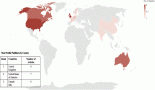
Results: N = 46 papers (2010–25) were retained, with n = 40 (93%) meeting the quality assessment criteria, fulfilling 4/5 MMAT criteria, with only n = 6 (13%) from the global south. Nurses were the most common PC providers, delivering patient communication and symptom management, either within multidisciplinary teams, in doctor–nurse dyads or as sole providers of PC. The term ‘early’ denoted initiation of PC: (a) within 8 weeks of an advanced cancer diagnosis, (b) linked to a cancer treatment phase or (c) based on an estimated prognosis of 6–24 months. Three models of integration were identified: (a) co-located concurrent care (basic integration of services), (b) interdisciplinary collaboration (e.g. team meetings and shared decision making), (c) fully embedded/unified care (e.g. co-rounding models or primary PC by oncology providers). With respect to transferability to low-resource settings, while the core principles are relevant, direct replication is limited by the evidence being from high-resource contexts. Models emphasising structured protocols, task shifting to nurses and simplified, adaptable interventions are considered more feasible, whereas complex, specialist team-dependent models raise moderate concerns for transferability.
Conclusion: Locally appropriate models are urgently needed to meet the needs of patients and families in the global south, which faces the greatest cancer burden.