The evidence base of Clinical Practice Guidelines for cancer in China, the Hong Kong SAR and Taiwan
Wei-Ting Wei, Grant Lewison and Richard Sullivan
King’s College London, Institute of Cancer Policy, Guy’s Hospital, Great Maze Pond, London SE1 9RT, UK
Abstract
We investigated the evidence base of Clinical Practice Guidelines (CPGs) on 10 major cancers from mainland China, the Hong Kong Special Administrative Region and Taiwan. We sought information about the delays between publication of the CPGs and their respective references, the geographical origins of the research reported in these references and the sources of funding for this research. We identified 396 CPGs from China, 42 from Hong Kong and 54 from Taiwan for ten major cancers, and 12,556, 3,652, and 4,485 references to these CPGs in the three territories, respectively. We determined the countries of the authors (for the non-Chinese references) and the Chinese provinces or cities (for the references in Chinese) and also analysed the funding sources for the research. Some 22% of the references cited in the CPGs from China were in Chinese, and some of their references were based on Traditional Chinese Medicine (TCM), particularly in mainland China and for gastrointestinal cancers. The references in the Chinese CPGs tended to cite Chinese research less than expected, but Japanese research rather more – as did the references in the Hong Kong and Taiwanese CPGs, which over-cited research from their own territories. The sources of financial support for the international references were mainly public grant-giving bodies and pharmaceutical companies from the USA, Japan and Europe, rather than the main Chinese governmental funders. The rapidly increasing Chinese cancer research output will make the latter funding sources more important in future, and they may also be expected to influence the evidence base of the Hong Kong and Taiwanese CPGs. However, since Chinese cancer research is very basic (rather than clinical), its direct influence on cancer care is likely to be less than might be expected.
Keywords: China, Hong Kong, Taiwan, cancer, Clinical Practice Guidelines, evidence base
Correspondence to: Grant Lewison
Email: grantlewison@aol.co.uk
Published: 03/11/2026
Received: 10/04/2026
Publication costs for this article were supported by ecancer (UK Charity number 1176307).
Copyright: © the authors; licensee ecancermedicalscience. This is an Open Access article distributed under the terms of the Creative Commons Attribution License (http://creativecommons.org/licenses/by/4.0), which permits unrestricted use, distribution, and reproduction in any medium, provided the original work is properly cited.
Introduction
This paper is about the development of Clinical Practice Guidelines (CPGs) in three very different territories largely populated by Chinese Han people. Our aim is to examine the research base underpinning their recommendations and to see where the research described in these papers was conducted. We have compared the amount of this research in these locations with their outputs of cancer research, as recorded in the Web of Science (WoS, © Clarivate Analytics plc).
The three healthcare systems
Since the takeover of mainland China by the Chinese Communist Party (CCP) in 1949, and the imposition of communist ideology, Chinese society and governance have been strongly influenced by these developments. More recently, its healthcare system has rapidly modernised and been greatly expanded [1], with notable achievements but also future challenges. There is a system of Social Health Insurance [2], but it is less comprehensive than the corresponding healthcare systems in the other two territories of the Hong Kong Special Administrative Region (SAR) and Taiwan. In China, a diagnosis of cancer still carries significant economic implications for patients [3]. Since the opening of China to capitalism and external investment in the 1970s, there are now some private hospitals alongside those funded by provinces and cities. However, healthcare provision is much better and more modern in the richer eastern cities and provinces than in the relatively underdeveloped western ones, although hospitals in the western region are quite efficient [4].
There has also been a policy shift toward integrating Traditional Chinese Medicine (TCM), which is seen as complementary to Western Medicine rather than as an alternative [5], and is well-liked [6]. It is particularly favoured in the less developed western provinces [7] and second- and third-tier cities.
Hong Kong was under British colonial rule from 1841 until the handover to China in 1997, when it became a SAR of China. During this time, the medical system resembled that in the United Kingdom (UK), with doctors and nurses being trained in English on the British syllabus. Major hospitals were created in association with the leading universities and are run by the Health Authority. The medical system still retains many of the UK features, with relatively inexpensive public hospital treatment (subsidised 97% by the government), although primary care is not free (as it still is in the UK). There is also an active private sector in healthcare in Hong Kong, but this has led to fragmented care [8, 9]. The Voluntary Health Insurance Scheme, regulated by the government, provides coverage for private treatment. The shortage of medical personnel and the ageing population mean that there are likely to be increasing problems in the future [10]. Nevertheless, Hong Kong enjoys one of the highest life expectancies in the world [11].
Taiwan was a Japanese colony from 1895 until it was taken back in 1945 by the Republic of China. Following their defeat on the mainland, the remnants of the Nationalist army, with many others, retreated to the island in 1949 and established Taiwan as an independent territory. Taiwan has a National Health Insurance scheme that provides comprehensive primary and secondary health coverage, including drugs, to virtually all its residents, with modest co-payments. Family physicians form an important component of the healthcare system [12], and TCM is also playing a role [13], but inevitably, an ageing population and pressures on costs are leading to forced economies [14].
The burden from cancer
All three territories suffer severely from cancer, in company with other developed economies, and as their populations age, the burden of the disease has increased. For example, cancer accounted for 12% of all Disability-Adjusted Life Years in China in 1990, but 16% in 2023. In Taiwan, the corresponding percentages rose from 14% to 20%. In Hong Kong, on the other hand, deaths from cancer decreased from 31% in 1991 to 24.5% in 2022, according to the Hong Kong Monthly Digest of Statistics for January 2024 (The Mortality Trend in Hong Kong, 1991 to 2022 1991年至2022年香港死亡趨勢). All three territories suffer the relatively greatest burden from lung cancer, primarily among males, as Chinese women smoke much less than men do, and in China, the percentage of females who smoke has dropped from 6% to 2%. In China, the relative burden from lung cancer has increased because so many Chinese men smoke, and the second manifestation is stomach cancer, though this is slowly decreasing. In Taiwan, colorectal cancer is second in terms of burden, and breast cancer is also important. In Hong Kong, the leading manifestations are similar to those in Taiwan [15], but the incidence of cancer among males has decreased from 300 per 100,000 to 230 in the period since 1990, largely because of the big reductions in male smoking to about 16% that have taken place.
The development of CPGs
These are being developed in many countries and used to inform and sometimes mandate good clinical practice. They can not only promote excellent cancer care but also minimise treatment variation and contain healthcare expenditures [16]. Hong Kong began discussing them in 2002, when a paper reported that patients in focus groups demanded them to receive better cancer care [17]. Their first mention in Taiwan was in a conference paper in 2001, where the use of two chemotherapy drugs in combination was found to be effective in breast cancer [18]. The first paper from mainland China was 2 years later, when F-Y Wang from Peking University contributed to a paper calling for CPGs to improve kidney disease treatment worldwide [19].
Normally, CPGs include a set of carefully selected references that provide the evidence base for their recommendations [20]. Many of these will be clinical trials or studies of new drugs or other procedures [21, 22]. There is evidence that the references in CPGs from a given country will be biassed towards research from that country [23]. To some extent, this may reflect the conditions pertaining there, such as the genetic composition of the inhabitants or features of the medical system. But there is also a general custom among CPG authors to over-cite their compatriots, just as authors of research papers do [24].
The analysis of the references in CPGs is a good means of showing how knowledge has real-world impact. It can show the results of support decisions by research funding bodies and provides an alternative quantitative method to evaluate clinical research, which is often undervalued by conventional citation counts relative to more basic biomedical research [25,26]. However, few studies compare results from analyses of the references in CPGs across different countries because many CPGs are written in the national language, so they are read by local medics, and the references are difficult to identify. Analysis of CPGs from China, Hong Kong SAR and Taiwan provides a deeper understanding of how cancer care has evolved in these understudied health ecosystems.
Methodology
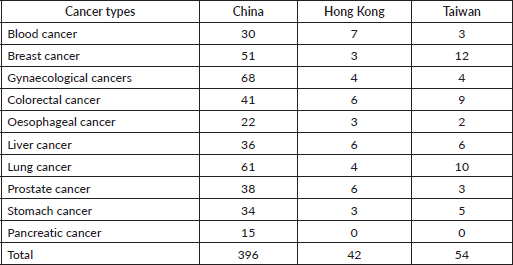
Our first task was to select the CPGs for analysis from the three territories. We decided to limit the selection to those covering the ten most common cancer manifestations, those listed in the caption to Figure 1. We searched for these CPGs for China in the China National Knowledge Infrastructure (中国知网), Wanfang Med. Online (万方医学网), yiigle (中华医学期刊全文数据库), Sinomed (中国生物ィ医学文献服务系统) and qikan (中文期刊服务平台). These were written in simplified Chinese. For the CPGs for Hong Kong and Taiwan, we searched the Airiti Library (華藝線上圖書館) in Traditional Chinese, the WoS (© Clarivate Analytics plc) and the websites of governmental bodies in these territories. We then removed duplicate CPGs and older versions of those that had been updated. We did this by comparing the CPG titles and the developers’ names and removed duplicate CPGs dated earlier than the most recent year. This yielded a total of 396 cancer CPGs from China (excluding Hong Kong), 42 from the Hong Kong SAR and 54 from Taiwan. Their distribution between the 10 cancer anatomical sites and the three territories is shown in Table 1.

Figure 1. Time gaps between the CPGs and their references from China (Chinese and non-Chinese references), Hong Kong and Taiwan, cumulative percentages.
Table 1. Numbers of CPGs on 10 cancer anatomical sites and for mainland China, the Hong Kong SAR, and Taiwan that were retained for analysis.
The next step was to identify all the references in these CPGs. For the Chinese ones, the majority (9,854 out of 12,556) were in non-Chinese languages (mainly in English) and could be identified in the WoS. The ones in Chinese were searched for in the Chinese databases listed above; these included 34 from Taiwanese CPGs (out of 4,486). All the CPGs from Hong Kong were in English, as were their references. Many of the references could be identified from the document identifiers or PubMed identifiers given in the references, even the Chinese ones. Others were identified from their titles and their authors’ names.
The bibliographic details of all these CPGs and references were written to an MS Excel spreadsheet for analysis. Parameters analysed were the time interval (in years) between publication of each CPG and its references; the mean research level (RL) of each set of references based on clinical, basic or both title words on a scale of RL = 1 for clinical work to RL = 4 for basic research [27]; and the fractional counts of the countries of the reference authors (or, for those in Chinese, the Chinese province/city). We also listed the leading journals in which the non-Chinese references were published and the main sources of funding for them. Finally, we determined the number of references that were concerned with TCM, which is of increasing interest in mainland China.
Results
The mean time gap between the publication of the CPGs and their references was 7.5 years in China and 7.6 years in Taiwan but 8.5 years in Hong Kong. The peak time for this gap was between 2 and 4 years for all three territories. Figure 1 shows the percentage exceedances for the four sets of CPG references. It is noticeable that the Chinese-language references in the Chinese CPGs were much more recent than the three other sets, with half being only 3 years earlier than the CPG, or more recent.
The mean RL of the non-Chinese references was determined as 1.11 for those from China, 1.16 for those from Hong Kong and 1.14 for the Taiwanese ones. These are all very clinical values, and they reveal that much cancer research that is quite basic will be unlikely to feature among these references.
The next analysis was of the geographical origins of the research reported in the references. For the Chinese language references in the Chinese CPGs, the research was nearly all from China itself, and our analysis is of the provinces, metropolitan cities and autonomous regions that contributed. The leading ones are listed in Table 2, with their percent contributions and their percentage presence in Chinese cancer research in 2009–2018 in international journals [28]. Beijing clearly dominates the research in these references, with almost three times the amount expected based on its research output within China in international journals.
The corresponding results for the countries whose research was contained in the non-Chinese references from the three sets of CPGs are shown in Table 3, on a fractional count basis. The comparator is the percentage presence of these countries (and Hong Kong, for its CPG references) in world cancer research, but on a hybrid count basis. This is the country’s integer count of papers divided by the total of the individual country contributions. This makes the sum of the country percentage presences equal to 100. The choice of comparator years, that is, from 2009 to 2018, corresponds to the central 70% of the dates of the non-Chinese references from Chinese CPGs.
It is perhaps surprising that the references in the Chinese CPGs over-cited papers from Japan, in view of the generally cool relations between the two countries, especially compared with the relations between Taiwan and Japan; see below. Moreover, although Chinese research is slightly over-cited, the ratio is much less than would be expected and the reason is probably that Chinese cancer research in international journals is relatively basic [29].
Table 2. The top 10 Chinese provinces contributing to the Chinese-language references from Chinese cancer CPGs. Chinese cancer research is in the WoS for 2009–2018.
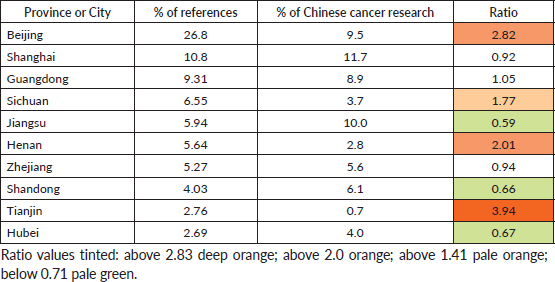
Table 3. The top 10 countries contributing to the non-Chinese language references from cancer CPGs from threee territories. Cancer research (Res.) is in the WoS for 2009–2018.
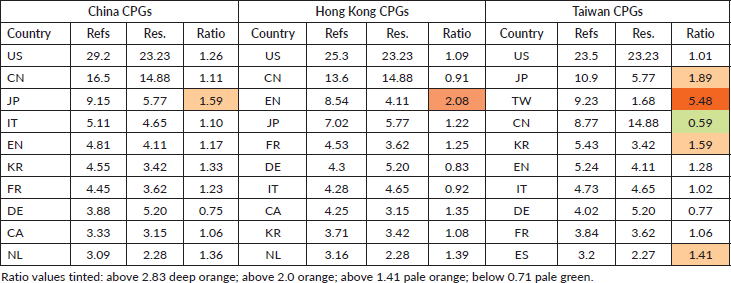
Hong Kong CPG references understandably over-cite research from the UK, and to a lesser extent that from Canada. This may be an indirect result of many Hongkongers emigrating to Canada, particularly to Vancouver and other cities in British Columbia [30, 31]. There were also 471 references to research in Hong Kong (13% of the total), compared with Hong Kong’s 0.6% presence in world cancer research in 2009–2018, a ratio of more than 21. The references from the Taiwanese CPGs also substantially over-cited Taiwanese research. Research from its neighbouring East Asian countries, Japan and South Korea, was relatively over-cited, but that from mainland China was relatively ignored.
Next, we determined the leading journals in which the non-Chinese references were published. These are shown in Table 4. It is striking that one journal, the Journal of Clinical Oncology, should play such a leading role, with almost twice the presence in the three sets of references as the next one, the New England Journal of Medicine.
TCM research accounted for 305 of the 2,702 Chinese language references in Chinese CPGs. Of these, 147 (48%) were from CPGs concerned with colorectal and gastrointestinal cancers. The popularity of TCM seems to have gone in waves, see Figure 2, with peaks in 2001, 2011 and 2021. This contrasts with the slight decrease in TCM output in Chinese-language journals in SinoMed over the last 10 years, but with big increase in its presence in the international journals covered in the WoS (see Figure 3).
As expected, the RL of all these references was very clinical. For the non-Chinese references, it was 1.10 for those from China, 1.16 for those from Hong Kong and 1.14 for the ones from Taiwan.
The last analysis was of the main funding sources for the research cited in the CPG references. For the Chinese ones, the two principal funders were the National Natural Science Foundation of China (n = 308; 11%) and the National Key Research and Development Program of China (n = 70; 3%). We found 397 different funders in total for these research papers. However, for the non-Chinese references, the main funders were the US Government through the National Institutes of Health (NIH), mainly the National Cancer Institute and European and US pharmaceutical companies (see Table 5).
Table 4. Percentages of references cited by cancer CPGs from three territories that were published in individual journals.
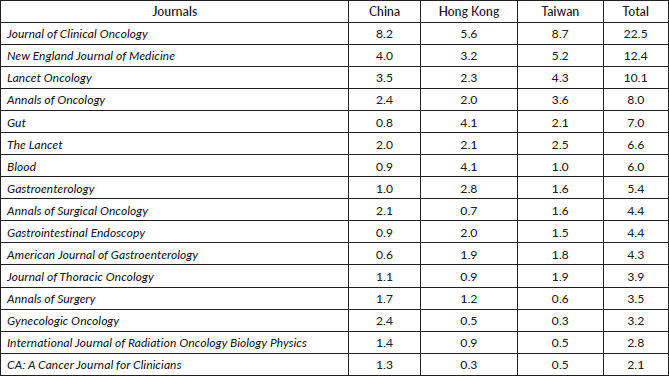
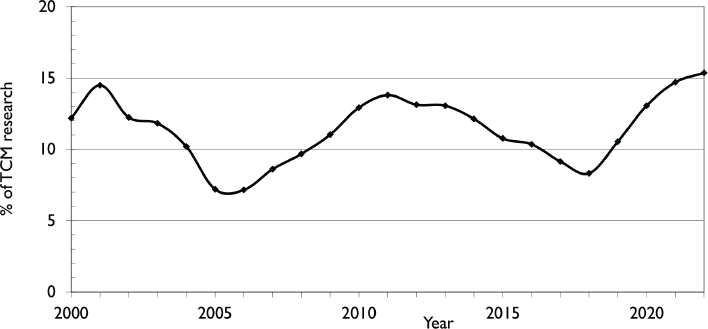
Figure 2. Percentage of the Chinese language references from Chinese cancer CPGs that were on TCM, 2000–2022. Three-year running mean.
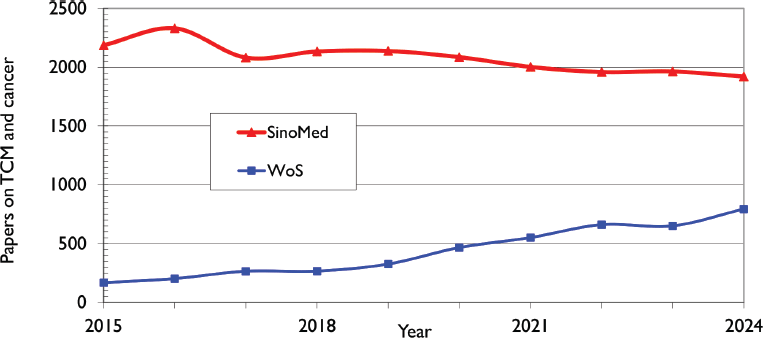
Figure 3. The outputs of cancer research papers from mainland China involving TCM in international journals (mostly in English) in the WoS and in Chinese-language journals in SinoMed.
Table 5. Organisations funding the research in the cancer CPG references from the three territories.

Discussion
This study has revealed the strong international contribution to the evidence underpinning CPGs in China, Hong Kong SAR and Taiwan. This is not surprising for Hong Kong and Taiwan, whose medical systems are well integrated internationally. However, it also occurs in mainland China, whose research focus is increasingly on international journals, with a decreasing output of papers in Chinese. There is also, in all three territories, a growing interest in TCM, but principally in mainland China, where it is being actively promoted by the government (see Figure 3), although it needs to be well grounded in good research practice [29]. By comparison, the corresponding output from Taiwan was only about 22 papers per year, and it has not changed over the last decade. There has been no such output from Hong Kong since 2019.
There is a clear variation in the percentage of references from the Chinese CPGs that are on TCM (Figure 2), with an oscillation from 7% of the total to 14%, over a period of 10 years. The ups and downs are related to changes in the official policy towards TCM. The slight increase from 2005 to 2010 was mainly due to a recovery in social trust following the 2003 SARS outbreak and the early signalling of supportive policies, such as the Regulations of PRC on TCM which established the legal status of TCM for the first time (http://en.nhc.gov.cn/2014-06/18/c_45755.htm#:~:text=Updated:%202014%2D06 %2D18the%20People's%20Republic %20of%20China). Moreover, a statement giving equal importance to TCM and “Western” medicine (modern medicine) was included in the report of the 17th National Congress of the Communist Party of China in 2007 (https://gb.china-embassy.gov.cn /eng/zywl/2007/200710/t20071031_3386927.htm). This led to the inclusion of a small amount of TCM evidence in guidelines. However, between 2010 and 2018 the drop in the percentage of TCM in the references reflected short-term market interests and the difficult struggle of TCM under the evaluation system and evidence standards dominated by “Western” science and experts with a “Western” medical education background (https://onlinelibrary.wiley.com/ doi/10.1155/2021/8883921) (https://www.bmj.com/content/360/bmj.j5158.long). The drop was reversed with the coming into effect of the 2017 TCM Law, which has fundamentally changed the “rules of the game” (http://www.scio.gov.cn/news_0/202209 /t20220921_422336.html). In addition, the 2019 National Conference on TCM led to its endorsement by the Central Committee of the CCP and the State Council. The subsequent Opinions on Promoting the Innovative Development of TCM has mandated collaboration between TCM and “western” medicine, requiring TCM experts to be included in guideline development, which led to the substantive influence of TCM in the development of guidelines (http://en.nhc.gov.cn/2019-10/29/c_75877.htm#:~:text=The%20document%20 stressed %20efforts%20to,quality%20development%20of%20the%20industry). Furthermore, TCM drug registration was reformed in 2020, with a more streamlined approval process
TCM. TCM also played a big part in the treatment of patients during the 2020 COVID-19 epidemic [32, 33], reinforcing its popularity and social acceptance. However, there are multiple reasons for the citation of TCM research. These include new scientific understanding of its effects, clinical demand by patients, and changes in TCM regulations, as well as the changes in CCP healthcare policy described above.
The distribution of the non-Chinese references by country (Table 3) revealed the expected over-citation of Taiwanese CPG references in Taiwanese cancer research (by a factor of 5.5), and the corresponding figure for Hong Kong was 21. However, the over-citation ratio for mainland China was only 11%. This may well be because Chinese cancer research (in international journals) is relatively basic and thus much less likely to be cited in CPGs despite the large population base, which would make conducting large randomised controlled clinical trials possible. However, the mean RL of the Chinese cancer research papers in the WoS has steadily become more clinical over the last 20 years [from 2.92 in 2005 to 2.22 in 2025]. It is therefore likely that, in the future, the presence of Chinese research among its CPG references will increase, and it will therefore have a greater influence on CPG recommendations and, consequently, more effect on Chinese cancer care.
For all three sets of references, two East Asian countries, namely Japan (JP) and South Korea (KR), are well cited, but especially by the Taiwanese CPGs. This may reflect their geographical proximity, but possibly also their growing political closeness to Taiwan. European countries are also moderately well-cited, notably England (EN), France (FR) and the Netherlands (NL), but not Germany (DE). Another notable example of under-citation is research from mainland China by Hong Kong CPGs, but even more so by those from Taiwan.
The results also show that the leading source of funding for all non-Chinese references is the US NIH, particularly its National Cancer Institute. This is especially notable for the references in the Chinese CPGs. Although the US Department of Health and Human Services (HHS; the parent of the NIH) was the second most frequently cited funder of Chinese cancer research, it supported only 2.9% of all these papers, much less than for the research in the CPG references. So, the Chinese cancer CPGs are primarily relying on US NIH funding, whereas those from Hong Kong cite research in which the proportion of this source of support is about equal to its level for Hong Kong cancer research in 2010–2025 (6.9%). For Taiwan, the percentage of US HHS funding for the research cited on its CPGs was slightly more than the funding of its cancer research (5.2%).
It may seem surprising that one journal, the Journal of Clinical Oncology, is so dominant among all three sets of CPG references. However, in our study of lung cancer CPGs from five European countries [26], we also found that this journal was the most cited, with twice as many references as the next most cited journal (Chest).
The study has some limitations. Bibliometric analysis, which is limited to simple counts of citations, does not take account of the greater influence of some clinical research, for example very large-scale clinical trials, over others. Moreover, in this study we have not identified the research papers that were cited in multiple CPGs, and so could be regarded as more useful. A further limitation is that the Chinese CPGs were published by many different authors and institutions. Some of these were government agencies or prestigious hospitals and universities in the relatively rich eastern cities and provinces, and they referenced many high-quality international papers. Others were published by second- and third-tier institutions in the western provinces, and they tended to cite local research, in keeping with the localisation policy of the Chinese central government. So, these CPGs would have been of lower general applicability, and perhaps not observed except in the hospitals where they were created.
Conclusion
It appears that Chinese CPGs are now much more evidence-based than formerly, but they are based more on international research than on work done in China. However, TCM is playing an increasing role in mainland China because of its active promotion by the Chinese government, and the greater rigour of studies that underpin it. It could well make a larger contribution to healthcare in other countries, too.
Acknowledgment
We are grateful to Yuping Qu of KCL for her helpful analysis of the possible reasons for the sine waves of Figure 2.
Author contributions
W-TW carried out the search for the CPGs in Chinese databases, identified their references both there and in the Web of Science and analysed their provenance and funding. He wrote an early draft of this paper, and he contributed much additional information. GL wrote the second draft of this paper, provided background information and carried out some analysis; he is the paper’s Corresponding Author. RS guided the project, which forms part of W-TW’s PhD study, as his supervisor, and provided strategic direction. All authors read and approved the final draft.
Conflicts of interest
None declared.
Funding
This research did not receive any external funding. W-TW is a self-funded PhD student at KCL. GL is an adjunct senior research fellow at KCL, and RS is a tenured professor there.
References
1. Chen C and Liu M (2023) Achievements and challenges of the healthcare system in China Cureus 15(5) e39030 PMID: 37378106 PMCID: 10292030
2. Gruber J, Lin M, and Yang H, et al (2025) China’s social health insurance in the era of rapid population aging JAMA Health Forum 6(4) e251105 https://doi.org/10.1001/jamahealthforum.2025.1105 PMID: 40279110
3. Chen L and Cheng M (2022) Exploring Chinese elderly’s trust in the healthcare system: empirical evidence from a population-based survey in China Int J Environ Res Public Health 19(24) 16461 https://doi.org/10.3390/ijerph192416461 PMID: 36554341 PMCID: 9779095
4. Xu X, Yasmeen R, and Shah WUH (2024) Efficiency evaluation, regional technological heterogeneity and determinant of total factor productivity change in China’s healthcare system Scientific Rep 14(1) 19606 https://doi.org/10.1038/s41598-024-70736-5
5. Zhou MC, Fei YT, and Lai XZ, et al (2024) Progress and challenges in integrated traditional Chinese and western medicine in China from 2002 to 2021 Front Pharmacol 15 1425940 https://doi.org/10.3389/fphar.2024.1425940
6. Mcquade JL, Meng Z, and Chen Z, et al (2012) Utilization of and Attitudes towards Traditional Chinese Medicine Therapies in a Chinese Cancer Hospital: a Survey of Patients and Physicians Evid Based Complement Alternat Med 504507 https://doi.org/10.1155/2012/504507 PMID: 23093982 PMCID: 3475319
7. Zhang W, Zhong LJ, and Tao SC, et al (2026) How does DRG reform affect length of stay and hospitalization costs in traditional Chinese medicine hospitals? — an empirical analysis using interrupted time-series model from two cities in western China Front Public Health 14 1762327 https://doi.org/10.3389/fpubh.2026.1762327
8. Lau C and Fong BY (2021) Review of public private partnership in health care in Hong Kong Asia Pacific J Health Manage 16(1) 33–39 https://doi.org/10.24083/apjhm.v16i1.637
9. Lee CKM, Tai WC, and Ng KKH (2020) System dynamic modelling of patient flow and transferral problem in a mixed public-private healthcare system: a case study of Hong Kong SAR J Syst Sci Syst Eng 29(5) 590–608 https://doi.org/10.1007/s11518-019-5454-4
10. Lam G (2023) Shortage of nurses in Hong Kong: the challenges ahead Asian Educ Develop Stud 12(1) 89–102 https://doi.org/10.1108/AEDS-08-2021-0179
11. Minton J and Wyper GM (2023) Life expectancy, healthy life expectancy, and inequalities in Hong Kong, 2007–2020 Lancet Regional Health–Western Pacific 41 https://doi.org/10.1016/j.lanwpc.2023.100931
12. Jan CF, Hwang SJ, and Chang CJ, et al (2020) Family physician system in Taiwan J Chin Med Assoc 83(2) 117–124 https://doi.org/10.1097/JCMA.0000000000000221
13. Lin SK and Lai JN (2024) Enhancing Traditional Chinese Medicine healthcare system in Taiwan post-COVID-19 pandemic: a strategic focus on specialization J Formosan Med Assoc 123(1) S207–SS14 https://doi.org/10.1016/j.jfma.2024.09.012 PMID: 39307619
14. Chao K (2025) Implementing Lean Healthcare in a Public Medical System: enhancing Public Health Services in Taiwan Eur J Public Health 35(Supplement_4) 161 https://doi.org/10.1093/eurpub/ckaf161.1561
15. Hong Kong Cancer Registry (2025) Overview of Hong Kong Cancer Statistics of 2023 (Hong Kong Hospital Authority) [https://www3.ha.org.hk/cancereg] Date accessed: 14/02/26
16. Legido-Quigley H, Panteli D, and Brusamento S, et al (2012) Clinical guidelines in the European Union: mapping the regulatory basis, development, quality control, implementation and evaluation across member states Health Policy 107(2-3) 146–156 https://doi.org/10.1016/j.healthpol.2012.08.004 PMID: 22939646
17. Pun Wong DK and Chow SF (2002) A qualitative study of patient satisfaction with follow-up cancer care: the case of Hong Kong Patient Educ Counseling 47(1) 13–21 https://doi.org/10.1016/S0738-3991(01)00168-9
18. Hsu C, Huang CS, and Chao TY, et al (2002) Phase II trial combining paclitaxel with 24‐hour infusion cisplatin for chemotherapy‐naïve patients with locally advanced or metastatic breast carcinoma Cancer Interdiscipl Int J Am Cancer Soc 95(10) 2044–2050
19. Eknoyan G, Lameire N, and Barsoum R, et al (2004) The burden of kidney disease: improving global outcomes Kidney Int 66(4) 1310–1314 https://doi.org/10.1111/j.1523-1755.2004.00894.x PMID: 15458424
20. Hong SJ, Yoon DY, and Lim KJ, et al (2019) Radiological Clinical Practice Guidelines Published in the Last Decade: a Bibliometric Analysis J Belg Soc Radiol 103(1) 37 [https://doi.org/10.5334/jbsr.1764] PMID: 31276091 PMCID: 6598615
21. Grant J, Cottrell R, Cluzeau F, Fawcett G (2000) Evaluating “payback” on biomedical research from papers cited in clinical guidelines: applied bibliometric study BMJ 320(7242) 1107–1111 https://doi.org/10.1136/bmj.320.7242.1107 PMID: 10775218 PMCID: 27352
22. Pallari E, Fox AW, and Lewison G (2018) Differential research impact in cancer practice guidelines’ evidence base: lessons from ESMO, NICE and SIGN ESMO Open 3(1) 258 https://doi.org/10.1136/esmoopen-2017-000258
23. Lewison G and Sullivan R (2008) The impact of cancer research: how publications influence UK cancer clinical guidelines Br J Cancer 98(12) 1944–1950 https://doi.org/10.1038/sj.bjc.6604405 PMID: 18521087 PMCID: 2441955
24. Bakare V and Lewison G (2017) Country over-citation ratios Scientometrics 113(2) 1199–1207 https://doi.org/10.1007/s11192-017-2490-z PMID: 29081556 PMCID: 5640755
25. Eriksson M, Billhult A, and Billhult T, et al (2020) A new database of the references on international clinical practice guidelines: a facility for the evaluation of clinical research Scientometrics 122(2) 1221–1235 https://doi.org/10.1007/s11192-019-03318-2
26. Pallari E, Eriksson M, and Billhult A, et al (2021) Lung cancer research and its citation on clinical practice guidelines Lung Cancer 154 44–50 https://doi.org/10.1016/j.lungcan.2021.01.024 PMID: 33611225
27. Lewison G and Paraje G (2004) The classification of biomedical journals by research level Scientometrics 60(2) 145–157 https://doi.org/10.1023/B:SCIE.0000027677.79173.b8
28. Li A and Lewison G (2020) Chinese cancer research in 2009–18 and the disease burden Cancer Manage Res 25(12) 5031–5040 https://doi.org/10.2147/CMAR.S253276
29. Zhang J, Li Y, and Zhang B, et al (2020) Evidence‐based traditional Chinese medicine research: beijing Declaration J Evidence-Based Med 13(2) https://doi.org/10.1111/jebm.12389
30. Lu D, Dou F, and Qi F, et al (2024) Tailored to fit: china optimizes policies and regulations regarding drug registration and review to promote innovation in traditional Chinese medicine Drug Discoveries & Therapeutics 18(4) 210–212 https://doi.org/10.5582/ddt.2024.01055
31. Long X, Zhang J, and Yang L (2025) Promoting the development and approval of new traditional Chinese medicines in China: a pooled analysis of data from 2013 to 2024 Front Med 12 1559703 https://doi.org/10.3389/fmed.2025.1559703
32. Pu J, Mei H, and Lei L, et al (2021) Knowledge of medical professionals, their practices, and their attitudes toward traditional Chinese medicine for the prevention and treatment of coronavirus disease 2019: a survey in Sichuan, China PLoS One 16(3) 234855 https://doi.org/10.1371/journal.pone.0234855
33. Zhang JL, Li WX, and Li Y, et al (2021) Therapeutic options of TCM for organ injuries associated with COVID-19 and the underlying mechanism Phytomedicine 85 153297 https://doi.org/10.1016/j.phymed.2020.153297