Background: Adjuvant endocrine therapy is a key treatment for early-stage hormone receptor positive (HR+)/HER2− breast cancer, but it often causes ongoing side effects that can affect quality of life and treatment adherence. Digital tools that collect symptoms directly from patients may help detect these problems earlier. However, there is limited real-world experience with these tools in South America.
Methods: We conducted a prospective, multicentre pilot study at the Paraguayan National Cancer Institute and the Alexander Fleming Institute from Argentina. Adult patients with early-stage HR+/HER2− breast cancer initiating adjuvant endocrine therapy (with or without abemaciclib) were enrolled. A mobile application incorporating 39 patient-reported outcomes-CTCAE (Spanish v1.0) items was used for longitudinal symptom monitoring. The primary outcome was adherence to questionnaire completion (≥2 questionnaires within the first year). Secondary outcomes included characterisation of adverse events and exploratory longitudinal analyses. Descriptive and inferential statistics were applied (p < 0.05).
Results: A total of 113 patients were included (median age 51.5 years). Overall, 231 questionnaires were completed. A total of 96 patients (85%) completed at least one questionnaire, 52.2% completed two and 35.4% completed three or more.
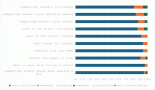
The most frequently reported symptoms were decreased libido (76%), hot flashes (72%), sadness (69%), dyspareunia (68%), insomnia (68%) and concentration issues (67%). Although most events were mild to moderate, severe reports ranged from 1% to 15% depending on the symptom. Neuroaffective and cognitive symptoms, such as sadness and concentration issues, were highly prevalent across subgroups.
Longitudinal analyses did not demonstrate statistically significant changes in symptom incidence or intensity over time, nor consistent differences between treatment subgroups, likely due to limited sample size.
The projected adherence target (73% completing ≥2 questionnaires) was not achieved.
Conclusion: Digital symptom monitoring in early breast cancer was feasible and revealed a substantial symptom burden, including emotional and cognitive dimensions that may be underdetected in routine consultations. However, adherence was lower than projected, underscoring the need to better understand implementation determinants before large-scale deployment. These findings support the clinical value of structured digital monitoring while highlighting the importance of optimising engagement strategies to ensure sustained use.