Introduction: Breast cancer remains the most frequently diagnosed cancer and the leading cause of cancer-related death in women worldwide, with incidence and mortality patterns in Latin America that differ substantially from high-income settings and vary considerably across countries within the region. Characterising current clinical practices and access to innovative therapies is essential to identify care gaps, inform regionally adapted guidelines and improve equity in cancer outcomes.
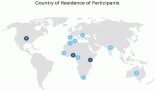
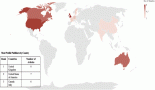
Methods: A cross-sectional, web-based survey was conducted among 223 breast cancer specialists from 20 Latin American countries between October and December 2025. This study was conducted and reported in accordance with the Checklist for Reporting of Survey Studies The structured questionnaire, developed by an expert panel from the Latin American Breast Cancer Association, explored three conceptually linked domains: response assessment (routine use of functional imaging), axillary management in specific post-neoadjuvant clinical scenarios and perceived commercial availability of targeted therapies for advanced breast cancer. Data were analysed using descriptive statistics.
Results: Of the 223 respondents, 64.5% (N = 144) routinely used functional imaging to assess neoadjuvant treatment (NAT) response. Pre-NAT marking of the metastatic axillary lymph node in cN1 patients was not performed routinely by 57.1% (N = 127). In hormone receptor-positive/ypN0(sn) patients undergoing breast-conserving surgery after NAT, 53.9% (N = 120) opted for regional nodal irradiation plus whole-breast radiotherapy. For human epidermal growth factor receptor 2 -positive and triple-negative tumours with residual macrometastasis in a sentinel lymph node, management strategies varied substantially; axillary radiotherapy alone was the most frequent choice (55.9% and 47.7%, respectively). Trastuzumab deruxtecan was reported as commercially available by 74.7% of 162 respondents, whereas sacituzumab govitecan (25.9%), capivasertib (15.4%), inavolisib (4.3%), alpelisib (19.8%) and elacestrant (8.6%) showed markedly lower availability.
Conclusions: This survey reveals substantial variability in post-NAT axillary management and pronounced disparities in access to novel agents across Latin America, even as certain evidence-based practices, such as routine functional imaging, are widely adopted. These findings underscore the need for regional consensus guidelines, structured educational programs and health policies targeting access barriers to high-quality breast cancer care.