Background: We performed a secondary analysis of a global survey conducted on de-novo Oligo-metastatic and Oligo-recurrent non-nasopharyngeal head and neck cancers (OM-HNC and OR-HNC) under the aegis of the Head and Neck Cancer International Group (HNCIG) to evaluate the current perceptions, incidence and treatment approaches across various continents.
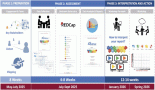
Material and methods: An 18-item questionnaire was developed by the HNCIG Young Investigator Subcommittee and distributed electronically to experts across 24 cooperative groups worldwide. Three rounds of invitations were sent, and responses were analysed using SPSS v24.
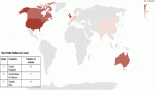
Results: A total of 204 responses were obtained and the majority (86.8%) were from academic institutes, with similar representation from different continents. The major responses were primarily from Europe (59.8%), followed by Asia (26.5%). Most respondents (81.9%) reported <10% incidence of de-novo OM-HNC, with regional variation (16%–20% reporting >10%,
mainly in Asia and Europe). Oligo-recurrence was encountered more frequently, with 28.9% reporting rates up to 20% and a minority reporting up to 30%. For de-novo OM-HNC, 64.7% favoured combining systemic therapy with local treatment to both primary and metastatic sites, which is consistent across all continents. For OR-HNC, though a combination of systemic therapy with metastasis-directed treatments (MDTs) was the most common approach across continents, up to one-third favoured MDT alone, especially in certain regions. Stereotactic body radiotherapy was the most frequently utilised MDT approach, used >50% of cases by 74.7% of respondents, with 18.7% using it exclusively.
Conclusion: This global survey highlights the variability in the incidence estimates and treatment approaches for OM-HNC and OR-HNC. While most clinicians endorse combining systemic therapy with MDT, a substantial minority consider MDT alone, reflecting ongoing uncertainty and the need for establishing evidence-based guidelines in the future.