Background: Prostate cancer is the second most common form of cancer and a leading cause of cancer-related death in men. In an era of evidence-based medicine, clinical trials play a critical role, and adherence to best practices is crucial in managing complicated and non-communicable diseases, such as prostate cancer. For this reason, extrapolating research conducted in high-income countries (HICs) to low-middle-income countries (LMICs) may lead to incorrect findings or treatment plans for patients in these areas. Unfortunately, clinical trials in LMICs face several challenges in terms of design, funding and recruitment. This study aimed to examine clinical trials on prostate cancer in LMICs, including the scope of these trials, the type of interventions being tested and funding sources.
Methods: A search of the Cochrane Library Controlled Trials Registry was conducted between January 2010 and June 2021 using keywords including: ‘prostate cancer’, ‘prostate adenocarcinoma’ and ‘prostate tumour’). The trials were classified into either HICs or LMICs based on the World Bank Atlas classification. A descriptive analysis was performed to determine the characteristics of the trials.
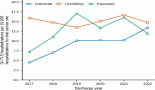
Results: A total of 3,455 clinical trials for prostate cancer have been conducted globally, with 542 (15.68%) conducted LMICs. Most of these trials (89%) were registered in upper-middle-income countries, with none being conducted in low-income countries. The majority of trials were prospective studies (98.1%), with 65.2% being randomised and 57% being phase III. Of the trials, 48.4% aimed to recruit fewer than 500 participants. The main source of funding was pharmaceutical companies in 78.1% of the cases, followed by institutional funds (16.1%) and public funds (5.8%). At the time of the search query, 74.6% of the trials were inactive, with 37% completed, 5% terminated due to insufficient funding and 75% terminated due to medical inefficacy or poor accrual. The majority of trials (88.2%) were interventional, with only 6% focusing on screening and prevention, and 2% designed for palliative care.
Conclusion: This study sheds light on the challenges faced in conducting clinical trials for prostate cancer in LMICs. The findings underline the need for improved support from international organisations and pharmaceutical companies to bridge the gaps in prostate cancer research and facilitate collaboration between researchers in LMICs and other countries.