Background The Internet has become a widely used resource for information on cancer and for support. As part of the EuroCancerComs project (www.eurocancercoms.eu), an intervention study has been designed. The study aims to help patients with cancer providing an Internet “space” where to find information about nutritional care.
Methods The study consists of a randomized 6-month intervention. The website (www.supportonutrizionale.it) hosts a contents area, prepared according to guidelines and recommendations, a forum and a blog. Subjects have been randomly allocated in intervention (IG) and control group (CG). IG has a free access to the website and it is involved in live activities, discussions and examinations. CG receives the same information by e-mail, without having access to the website. Three questionnaires are used to evaluate the effectiveness of the approach, concerning quality of life (QoL), psychological status and nutrition facts.
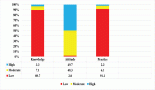
Results Since the study startup, 191 subjects have been screened, and 58 (30%) have been randomized. Participants in both groups are mainly females, married and have at least a high school education level. Participants experienced a high psychological distress for 27% of IG and 33% of CG considering the four classes of scores at the baseline. Regarding QoL, a low “role functioning” score for IG and “emotional functioning” and “social functioning” scores for both groups are reported, while “fatigue” and “nausea and vomiting” respectively for IG and CG are the worsened symptoms compared with reference values. Considering the nutrition facts questionnaire, subjects showed a medium-high score profile and the worst scale regards “Nutrition and cancer knowledge”. From the beginning of the study, a total of 48 actions have been registered, including votes to contents, comments and forum messages.
Conclusion The Internet has made possible the new forms of interaction and knowledge, and it is likely to become essential to gain access to health information. The results of this randomized intervention may help in the evaluation of the efficacy of these interventions in cancer setting.