Use of methadone for paediatric oncology patients in palliative care: a systematic review
Hannya Aline Barrón Alcántara1 , María Silvia Cruz Rodríguez2, Sofia Valeria Huerta Rivas3 and Luz Eugenia Alcántara Quintana4
1Medical Intern of Social Service, School of Medicine, Autonomous University of Valley de México, San Luis Potosí, 78220, Mexico
2Palliative Care Unit, Hospital Regional de Alta Especialidad Dr. Ignacio Morones Prieto, San Luis Potosí, 78290, Mexico
3Pain Clinic, Alta Especialidad Regional Hospital, Ignacio Morones Prieto, Zona Universitaria, San Luis Potosí, 78290, Mexico
4Unit of Innovation and Diagnosis in Cellular and Molecular Biology of the Coordination for the Innovation and Application of Science and Technology (CIACyT), Autonomous University of San Luis Potosí, San Luis Potosí, 78200, Mexico
Abstract
Background: Cancer pain in paediatric patients represents a major clinical challenge, particularly in advanced disease and palliative care settings. Methadone has been proposed as an alternative for refractory pain due to its unique pharmacological profile.
Objective: To evaluate the available evidence on the efficacy and safety of methadone in paediatric oncology patients receiving palliative care.
Methods: A systematic review was conducted following Preferred Reporting Items for Systematic Reviews and Meta-Analyses 2020 guidelines. A search was performed in PubMed/MEDLINE (11 February 2026) using terms related to methadone, paediatric cancer and palliative care. Studies including patients aged 0–17 years treated with methadone for cancer-related pain were included. A qualitative narrative synthesis was performed.
Results: Eleven studies were included, primarily retrospective studies and case series. Methadone was associated with significant improvement in pain control, reduced pain intensity and decreased need for rescue medication. Dosing regimens varied widely. The incidence of clinically significant QT interval prolongation was low, with no reported serious arrhythmias. Adverse effects were mostly mild.
Conclusion: Methadone appears to be an effective and generally safe alternative for managing refractory cancer pain in paediatric patients. However, evidence is limited, highlighting the need for prospective studies. These findings support the cautious integration of methadone into paediatric palliative care protocols under appropriate monitoring.
Keywords: methadone, paediatric oncology, palliative care, cancer pain, analgesia, safety
Correspondence to: Luz Eugenia Alcántara-Quintana
Email: luz.alcantara@uaslp.mx ; lealcantara@secihti.mx
Published: 06/10/2026
Received: 17/04/2026
Publication costs for this article were supported by ecancer (UK Charity number 1176307).
Copyright: © the authors; licensee ecancermedicalscience. This is an Open Access article distributed under the terms of the Creative Commons Attribution License (http://creativecommons.org/licenses/by/4.0), which permits unrestricted use, distribution, and reproduction in any medium, provided the original work is properly cited.
Introduction
Pain is one of the most prevalent and debilitating symptoms in paediatric cancer patients, particularly in advanced stages of the disease and in the context of palliative care [1,2]. Despite advances in cancer therapies, a significant proportion of children experience persistent, mixed or refractory pain, which negatively impacts their quality of life and that of their families [2].
The management of paediatric cancer pain presents a clinical challenge due to the pathophysiological complexity of the pain, which frequently involves nociceptive and neuropathic components, as well as tolerance, opioid-induced hyperalgesia and adverse effects associated with prolonged treatment [3,5]. Conventional opioids such as morphine, oxycodone or fentanyl form the basis of analgesic treatment; however, in some cases, they prove insufficient or cause limiting side effects. In this context, opioid rotation and the use of therapeutic alternatives have been strategies employed in paediatric palliative care [4,6].
Methadone is a synthetic opioid with unique pharmacological properties, including agonist activity at μ-opioid receptors and antagonism of the N-methyl-D-aspartate (NMDA) receptor, which confers potential utility in the treatment of neuropathic pain and in situations of tolerance to other opioids [5]. Furthermore, its prolonged half-life allows for less frequent dosing regimens, which may be beneficial in patients with advanced disease [3,6].
However, the use of methadone in the paediatric population has been limited by its complex pharmacokinetic profile and by precautions related to prolongation of the corrected QT interval (QTc) and the potential risk of arrhythmias [7]. Studies in paediatric oncology patients have shown a low incidence of clinically significant arrhythmic events under adequate monitoring [8,9]. Consequently, the available evidence in children with cancer receiving palliative care is less robust compared to the adult population, with a predominance of retrospective studies and case series, highlighting the need to systematise the available information.
Given the clinical importance of adequate pain management in this vulnerable population and the need to inform evidence-based therapeutic interventions, this systematic review was conducted to evaluate the available evidence on the efficacy and safety of methadone in paediatric cancer patients receiving palliative care.
Methods
The review process followed PRISMA recommendations for study identification, screening and inclusion.
Study design
A systematic literature review was conducted following the guidelines of the PRISMA 2020 statement (Preferred Reporting Items for Systematic Reviews and Meta-Analyses), with the aim of identifying and evaluating the evidence on the efficacy and safety of methadone in paediatric oncology patients, including palliative care settings and advanced disease.
This review was not previously registered on platforms such as PROSPERO.
Research question
The research question was structured using the Population, Intervention, Comparator and Outcome (PICO) model to precisely define the scope of the systematic review and guide the literature search strategy.
P (Population): paediatric patients (0–17 years) with a cancer diagnosis in the context of palliative care or advanced disease
I (Intervention): use of methadone as an analgesic for pain management
C (Comparator): other opioids or standard analgesic treatment, when available
O (Outcome): analgesic efficacy and safety, including reduction in pain intensity, need for rescue doses and adverse events, particularly QTc prolongation
Based on this framework, the research question was: What is the available evidence regarding the efficacy and safety of methadone in paediatric oncology patients receiving palliative care?
Search strategy
The literature search was conducted in the PubMed/MEDLINE database on 11 February 2026. MeSH terms and keywords were used in combination with Boolean operators (AND/OR). The search strategy included terms related to ‘methadone’, ‘paediatric’, ‘child’, ‘cancer’, ‘palliative care’, ‘refractory pain’ and ‘cancer pain’.
(Methadone) AND (paediatric OR child) AND (cancer OR palliative care OR refractory pain OR cancer pain).
The following filters were applied: humans, no restriction on year of publication, English language and paediatric population (0–17 years).
Inclusion and exclusion criteria
Inclusion criteria
-
Studies in paediatric patients (0–17 years)
-
Oncological diagnosis
-
Palliative care setting or advanced disease
-
Use of methadone as an analgesic
-
Original studies with clinical data
-
Publications in English and Spanish
Exclusion criteria
-
Studies exclusively in adults
-
Use of methadone for opioid use disorder
-
Studies without reported clinical outcomes
-
Duplicate articles
-
Narrative reviews without primary data
-
Articles without access to full text
Selection process
Study selection was performed by a single reviewer through the evaluation of titles, abstracts and full texts. In cases of doubt, articles were re-evaluated to confirm their eligibility.
The initial search identified 131 records. After removing 4 duplicates, 127 titles and abstracts were evaluated, and 104 were excluded for failing to meet the eligibility criteria. Twenty-three full-text articles were sought, of which 4 could not be retrieved. Nineteen full-text articles were evaluated, and 8 were excluded for the following reasons: exclusively adult population (n = 2), absence of clinical outcomes (n = 4) and non-cancer-related pain (n = 2). Finally, 11 studies were included in the qualitative synthesis.
The selection process was documented using a PRISMA flow diagram (Figure 1).
Data extraction
Data extraction was performed by one reviewer
The following data were extracted from the studies: country, study design, sample size, population characteristics, methadone dose, treatment duration, analgesic efficacy and reported adverse events.
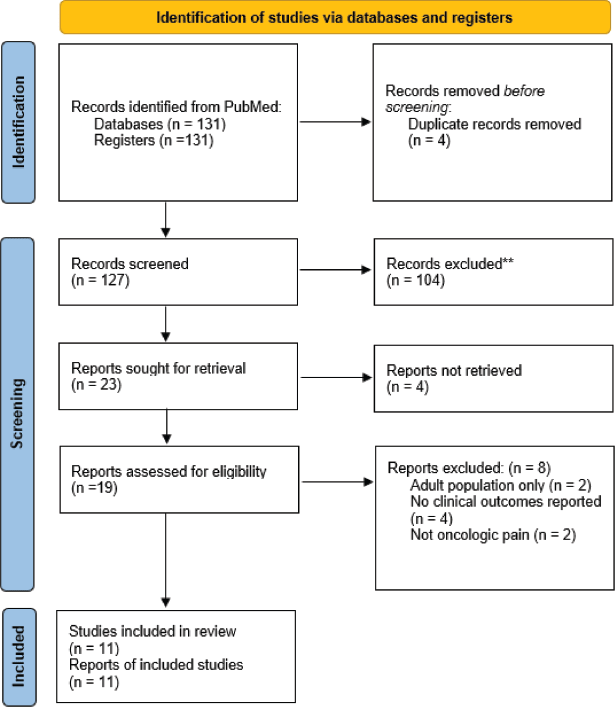
Figure 1. A total of 131 records were identified in PubMed. After removing 4 duplicates, 127 titles/abstracts were evaluated, and 104 were excluded. Twenty-three full-text articles were sought; 4 were not retrieved. Nineteen full-text articles were evaluated, and 8 were excluded (2 because they involved an adult population, 4 because they did not report clinical outcomes and 2 because they did not pertain to cancer pain). Eleven studies were included in the qualitative synthesis.
Quality assessment and risk of bias
Overall, the risk of bias across studies was considered moderate to high due to the predominance of retrospective designs and small sample sizes.
Data synthesis
A qualitative narrative synthesis of the results was performed due to the heterogeneity in study designs, population characteristics, dosing regimens and reported outcomes, which precluded a quantitative meta-analysis.
Results
General characteristics of the included studies
A summary of the main characteristics and findings of the included studies is presented in Table 1. Eleven studies published between 2000 and 2024 were included, primarily from the United States, Canada, Argentina, Denmark, Germany and Australia. Most were retrospective studies, medical record reviews and case series in paediatric populations with advanced cancer, cancer-related pain or life-limiting illness. Overall, the studies included approximately 250 paediatric patients, ranging in age from infants to adolescents and young adults. Most patients were in advanced stages of the disease, with pain refractory to conventional opioids or with a significant neuropathic component. The predominant study designs were as follows.
-
Retrospective studies
-
Case series
-
Clinical case reports
-
Studies focusing on cardiovascular safety (QTc)
No randomised clinical trials in an exclusively paediatric population were identified.
Dosage regimens and usage strategies
Initial methadone doses varied widely across studies. The most common initial oral doses ranged from 0.05 to 0.1 mg/kg every 8–12 hours, with gradual titration based on clinical response [3,5,9].
In these opioid rotation studies, morphine-to-methadone conversion ratios varied widely, with ratios ranging from 10:1 to 60:1, reflecting the need for an individualised approach [2,6,10].
In some special cases, very-low-dose-methadone regimens were reported for refractory neuropathic pain, with doses <50% of the initial standard analgesic dose [5].
Cases of intravenous methadone use at extremely high doses (>10 mg/kg/day) were also documented in situations of severe chemotherapy-induced neuropathic pain, always under strict monitoring [10].
The duration of treatment varied considerably, ranging from a few days in the terminal phase to several months in patients with advanced disease.
Analgesic efficacy
Most studies reported a significant improvement in pain following the introduction of methadone. In studies using validated scales, statistically significant reductions in pain scores reported by patients and parents were documented (p < 0.0001 in retrospective comparative studies) [3].
In several studies, more than 70% of patients did not require frequent dose adjustments after initial stabilisation [3]. In case reports, reductions of up to 4–5 points on numerical pain scales were observed [10,11].
Table 1. Summary of the included studies evaluating methadone in paediatric oncology patients.

Likewise, a decrease in the use of rescue doses and improvement in associated symptoms such as insomnia, fatigue and neuropathic pain were described [5,10].
Across the included studies, methadone consistently demonstrated efficacy in reducing pain intensity, particularly in refractory and neuropathic pain. Most evidence derives from retrospective designs, with a limited number of prospective observations. Safety outcomes were favourable, with a low incidence of clinically significant QTc prolongation and no reported life-threatening arrhythmias.
Safety and adverse effects
The reported adverse events were mostly mild and consisted of drowsiness, nausea and constipation [1,3,6]. No serious events of respiratory depression were documented in the included studies.
Regarding cardiovascular safety, multiple studies evaluated QTc interval prolongation using serial electrocardiograms [7-9]. The incidence of significant QTc prolongation was low. In most cases, the changes were mild and were not associated with torsades de pointes or sudden death [8,9].
In cases of prolonged QTc, concomitant factors such as electrolyte imbalances or drug interactions with medications such as fluconazole were identified [10]. Correction of these factors allowed for normalisation of the QTc without the need to discontinue methadone in most cases.
Discussion
Main findings and clinical relevance
This systematic review synthesises the available evidence regarding the use of methadone for cancer-related pain in paediatric patients, particularly within palliative care settings. Overall, the findings suggest that methadone is consistently associated with clinically meaningful reductions in pain intensity, decreased reliance on rescue analgesia and improved symptom control, including neuropathic pain components.
Importantly, methadone appears to be especially beneficial in cases of refractory pain, where conventional opioids fail to provide adequate analgesia or are limited by adverse effects. This reinforces its role not merely as an alternative opioid, but as a pharmacologically distinct agent with potential advantages in complex pain syndromes due to its dual mechanism of action (μ-opioid receptor agonism and NMDA receptor antagonism).
From a clinical standpoint, these findings support the integration of methadone into paediatric palliative care protocols, particularly in advanced disease and end-of-life care, where optimizing comfort remains a primary goal. This is particularly relevant in resource-limited settings, where access to specialised pain management strategies may be constrained.
Comparison with existing literature
Although robust paediatric-specific evidence remains limited, the findings of this review are consistent with adult oncology literature, where methadone has demonstrated efficacy in managing refractory and neuropathic cancer pain. The extrapolation of adult data to paediatric populations has historically been approached with caution; however, the consistency of analgesic outcomes observed across the included studies suggests that similar pharmacodynamic benefits may be achieved in children when appropriate dosing and monitoring strategies are applied.
Notably, the absence of randomised controlled trials in paediatric oncology contrasts with the growing body of evidence in adults, highlighting a significant translational gap. This discrepancy underscores the ethical and methodological challenges inherent to paediatric palliative care research but also emphasises the need for innovative study designs to generate higher-quality evidence.
Safety considerations and cardiac risk
One of the principal concerns associated with methadone use is its potential to prolong the QTc interval and increase the risk of life-threatening arrhythmias. However, the studies included in this review consistently report a low incidence of clinically significant QTc prolongation and, notably, an absence of torsade de pointes or sudden cardiac death.
These findings suggest that, within the context of careful patient selection and appropriate monitoring, methadone can be considered a safe therapeutic option in paediatric oncology. Importantly, reported cases of QTc prolongation were frequently associated with modifiable factors such as electrolyte imbalances or drug–drug interactions, rather than methadone exposure alone.
This highlights a critical point for clinical practice: the safety of methadone is highly dependent on comprehensive monitoring strategies, including electrocardiographic evaluation and management of concomitant risk factors, rather than avoidance of the drug itself.
Variability in dosing and clinical implications
A key finding of this review is the substantial heterogeneity in methadone dosing regimens and opioid conversion ratios. Initial dosing strategies ranged widely, and conversion ratios from morphine varied from 10:1 to 60:1 across studies.
This variability reflects the complex and nonlinear pharmacokinetics of methadone, as well as interindividual differences in metabolism, particularly in paediatric patients. While individualised dosing is appropriate in clinical practice, the lack of standardised protocols represents a significant barrier to broader implementation and may contribute to clinician hesitancy.
The development of evidence-based dosing guidelines tailored to paediatric populations should therefore be considered a research priority, as it would enhance both the safety and accessibility of methadone as an analgesic option.
Limitations of the evidence
The strength of the conclusions drawn from this review is limited by the nature of the available evidence. Most included studies were retrospective, with small sample sizes and heterogeneous populations. Additionally, variability in outcome measures, pain assessment tools and reporting of adverse events limits comparability across studies.
The absence of randomised controlled trials represents a major gap in the literature. While understandable given the ethical and logistical challenges of conducting such studies in paediatric palliative care, this limitation restricts the ability to establish causal relationships and definitive clinical recommendations.
Furthermore, the reliance on a single database (PubMed/MEDLINE) may have resulted in the omission of relevant studies indexed elsewhere, particularly in regional or non-English-language sources.
Implications for future research
Future research should focus on prospective, multicentre studies designed to evaluate the efficacy and safety of methadone in paediatric oncology populations using standardised protocols. Particular attention should be given to the following.
-
Optimal dosing strategies and titration schedules
-
Standardised opioid conversion ratios
-
Longitudinal assessment of cardiac safety
-
Patient-reported outcomes and quality of life measures
In addition, the inclusion of data from low- and middle-income countries is essential to ensure that findings are globally applicable, especially given the disparities in access to pain management resources.
In summary, the available evidence supports methadone as an effective and generally safe option for the management of refractory cancer pain in paediatric patients. However, the current evidence base remains limited and heterogeneous. Strengthening the quality of clinical research in this area is essential to establish standardised, evidence-based guidelines and to optimise pain management in this vulnerable population.
Conclusions
The available evidence suggests that methadone is an effective and generally safe alternative for the management of cancer-related pain in the paediatric population, particularly in cases of advanced disease and pain refractory to conventional opioids. Across the included studies, methadone was consistently associated with clinically meaningful reductions in pain intensity, decreased use of rescue medication and an acceptable safety profile when administered under appropriate monitoring.
However, the current evidence base is limited, as it relies predominantly on retrospective studies, case series and clinical reports with small sample sizes. This, together with the marked heterogeneity in dosing regimens and opioid conversion strategies, limits the generalisability of findings and highlights the absence of standardised clinical protocols.
Future research should prioritise well-designed prospective and multicentre studies to systematically evaluate the efficacy, safety and cardiac effects – particularly QTc interval changes – of methadone in paediatric oncology patients. Strengthening the quality of evidence in this field is essential to support clinical decision-making and to establish standardised, evidence-based guidelines for the management of paediatric cancer pain.
Funding
No external funding was received for the conduct of this review.
Conflicts of interest
The authors declare that they have no conflicts of interest.
Data availability
The data used in this review are available upon request from the author.
References
1. Hall EA, Sauer HE, and Habashy C, et al (2021) Methadone for cancer pain in pediatric end-of-life care Am J Hosp Palliat Care 38(8) 914–919 https://doi.org/10.1177/1049909120963641
2. Davies D, Devlaming D, and Haines C (2008) Methadone analgesia for children with advanced cancer Pediatr Blood Cancer 51(3) 393–397 https://doi.org/10.1002/pbc.21584
3. Madden K, Mills S, and Dibaj S, et al (2018) Methadone as the initial long-acting opioid in children with advanced cancer J Palliat Med 21(9) 1317–1321 https://doi.org/10.1089/jpm.2017.0712
4. Yazde Puleio ML, Gómez KV, and Majdalani A, et al (2018) Opioid treatment for mixed pain in pediatric patients assisted by the palliative care team: five years of experience Arch Argent Pediatr 116(1) 62–64 [https://doi.org/10.5546/aap.2018.eng.62] PMID: 29333821
5. Madden K and Bruera E (2017) Very-low-dose methadone to treat refractory neuropathic pain in children with cancer J Palliat Med 20(11) 1280–1283 https://doi.org/10.1089/jpm.2017.0098
6. Mott C, Sarpal A, and Moss K, et al (2018) Methadone for analgesia in children with life-limiting illness: experience from a tertiary children’s health service Children (Basel) 5(7) 86 [https://doi.org/10.3390/children5070086] PMCID: 6068960
7. Anghelescu, Md DL, Patel, Md RM, Mahoney, and Md DP, et al (2016) Methadone prolongs cardiac conduction in young patients with cancer-related pain J Opioid Manag 12(2) 131–138 https://doi.org/10.5055/jom.2016.0325 PMID: 27194198 PMCID: 5073866
8. Madden K, Jo E, and Williams JL, et al (2019) Corrected QT interval prolongation in pediatric and young adult patients on methadone for cancer-related pain J Pain Symptom Manage 58(4) 678–684 https://doi.org/10.1016/j.jpainsymman.2019.05.021 PMID: 31195079
9. Madden K, Park M, and Liu D, et al (2017) The frequency of QTc prolongation among pediatric and young adult patients receiving methadone for cancer pain Pediatr Blood Cancer 64(11) e26614 https://doi.org/10.1002/pbc.26614
10. Rasmussen VF, Lundberg V, and Jespersen TW, et al (2015) Extreme doses of intravenous methadone for severe pain in two children with cancer Pediatr Blood Cancer 62(6) 1087–1090 https://doi.org/10.1002/pbc.25392 PMID: 25641929
11. Sabatowski R, Kasper SM, and Radbruch L (2002) Patient-controlled analgesia with intravenous L-methadone in a child with cancer pain refractory to high-dose morphine J Pain Symptom Manage 23(1) 3–5 https://doi.org/10.1016/S0885-3924(01)00389-X PMID: 11779660