Survival outcomes of adapted paediatric cancer treatment protocols in Cameroon and collaborating sub-Saharan African centres: a systematic review and meta-analysis
Yvonne Nyiambam Waindim1,2a, Glenn Mbah Afungchwi2,3, Fongang Che Landis3, Angele-Hermine Pondy-Ongotsoyi4,5 and Mary Bi-Suh Atanga3
1Department of Public Health, Faculty of Health Sciences, The University of Bamenda, PO Box 39, North West Region, Bambili, Bamenda, Cameroon
2World Child Cancer, First Floor, Abunde’s Building, Up Station, Bamenda, Cameroon
3Department of Nursing and Midwifery, Faculty of Health Sciences, The University of Bamenda, PO Box 39, North West Region, Bambili, Bamenda, Cameroon
4Department of Oncology/Hematology, Mother and Child Center, Chantal Biya Foundation, PO Box 1936, Yaoundé, Cameroon
5Department of Pediatrics, Faculty of Medicine and Biomedical Sciences, University of Yaounde 1, PO Box 1364, Yaoundé, Cameroon
a https://orcid.org/0000-0002-3253-0984
Abstract
Survival outcomes for childhood cancers remain substantially lower in low- and middle-income countries than in high-income countries, largely due to late diagnosis, limited supportive care and treatment abandonment. In response to these challenges, Cameroon and collaborating Sub-Saharan African centres have implemented adapted paediatric cancer treatment protocols designed to balance effectiveness with feasibility in resource-constrained settings. Yet, the survival impact of these adaptations has not been systematically synthesised. We conducted a systematic review of studies published over the past 20 years that reported treatment protocols and survival outcomes among children and adolescents with cancer in Cameroon or in multicentre African studies that included Cameroonian patients. Searches were run in PubMed, Google Scholar, African Journals Online and grey literature sources. Study selection followed the Preferred Reporting Items for Systematic Reviews and Meta-Anal 2020 guidelines, and risk of bias was assessed using ROBINS-I. A random-effects meta-analysis was used, given the expected clinical and methodological heterogeneity. Twelve studies, including 1,984 participants, were included; four were conducted only in Cameroon, and eight were multicentre African studies including Cameroon. Most protocols were adapted from the International Society of Paediatric Oncology and Groupe Franco-Africain d’Oncologie Pédiatrique guidelines. Because studies differed in reported outcomes, study design and comparator structure, comparative odds ratios (ORs) were pooled for exploratory purposes only and were not interpreted as a single causal measure of protocol effectiveness. An initial random-effects model showed substantial heterogeneity (I2 = 85%). The strongest and most consistent pattern was seen in stage-based comparisons, where children diagnosed earlier had much better outcomes than those presenting with advanced disease (pooled OR 5.89, 95% CI 3.38–10.29). By contrast, implementation/time-based comparisons and protocol-versus-protocol comparisons were smaller and less stable in sensitivity analysis. Overall, adapted protocols appear to support encouraging outcomes, but the clearest advantage was linked to earlier diagnosis rather than to a uniform protocol effect. More standardised outcome reporting and stronger prospective studies are needed.
Keywords: paediatric cancer, adapted treatment protocols, survival outcome, Cameroon, sub-Saharan Africa, LMICs
Correspondence to: Yvonne Nyiambam Waindim
Email: waindimy@gmail.com
Published: 19/08/2026
Received: 19/01/2026
Publication costs for this article were supported by ecancer (UK Charity number 1176307).
Copyright: © the authors; licensee ecancermedicalscience. This is an Open Access article distributed under the terms of the Creative Commons Attribution License (http://creativecommons.org/licenses/by/4.0), which permits unrestricted use, distribution, and reproduction in any medium, provided the original work is properly cited.
Introduction
Where a child lives remains one of the strongest determinants of their chances of surviving a cancer diagnosis [1]. While more than 80% of children diagnosed with cancer in high-income countries (HICs) now survive, outcomes in many low- and middle-income countries (LMICs), including Cameroon, remain substantially poorer, with survival rates often below 30% [2]. Over the past several decades, survival gains in HICs have been driven by advances in multimodal therapy, cooperative group clinical trials, improved supportive care and innovations in risk-adapted treatment strategies [3, 4]. In contrast, childhood cancer care in LMICs continues to be challenged by limited infrastructure, shortages of specialised personnel, constrained diagnostic capacity and higher rates of both late presentation and treatment abandonment [3, 5, 6].
In response, paediatric oncology programmes in LMICs have increasingly adopted adapted treatment protocols, often because locally conducted clinical trials are scarce and programmes must modify protocols developed elsewhere to fit available diagnostic, supportive care and treatment resources. The adaptation often involves reduced-intensity chemotherapy regimens designed to minimise toxicity in settings where supportive care resources are limited [3, 5, 7]. Several collaborative initiatives, including the Groupe Franco-Africain d’Oncologie Pédiatrique (GFAOP) [8] and the Collaborative African Network for Childhood Cancer Care (CANCaRe Africa) [9], have successfully implemented such adapted protocols across Sub-Saharan Africa. These initiatives aim to balance treatment effectiveness with local feasibility while addressing challenges related to late diagnosis, comorbidities and health system constraints. Evidence suggests that adapted protocols can improve survival outcomes, particularly for highly curable cancers such as Wilms tumour, Burkitt lymphoma and Hodgkin lymphoma [10–12].
Cameroon provides a particularly relevant context for examining the effectiveness of adapted paediatric cancer treatment protocols. As an LMIC with a population of over 28.4 million [13], Cameroon is among the Global Initiative for Childhood Cancer (GICC) focus countries in the WHO Afro Region [14]. Childhood cancers account for approximately 1%–2% of all cancers in the country, with lymphomas, acute leukaemias, nephroblastomas and retinoblastomas being the most prevalent [15]. Before the year 2000, there were no dedicated paediatric oncology services in Cameroon [16]. Significant progress has since been made with the establishment of two specialised paediatric oncology programmes: one at the Mother and Child Center-Chantal Biya Foundation (MCC-CBF) in Yaoundé and another within the Cameroon Baptist Convention Health Services (CBCHS), with a hub at Mbingo Baptist Hospital [16]. These programs offer paediatric chemotherapy, surgery and palliative care, although radiotherapy and nuclear medicine services remain largely unavailable nationally [15]. Nonetheless, recent progress in the provision of radiotherapy has been made, with the Cameroon Oncology Centre now providing radiotherapy [17], and the construction of a bunker for radiotherapy at Mbingo Baptist Hospital is underway.
The treatment protocols implemented in these centres are largely adaptations of international guidelines, modified to reflect local resource availability and supportive care capacity [16]. While individual studies from Cameroon and collaborative African trials have reported encouraging survival outcomes following the introduction of these adapted protocols, the available evidence remains fragmented [16]. Although the number of Cameroon-only outcome studies remains modest, paediatric oncology in Cameroon has developed substantially through multicentre African collaboration that included Cameroonian centres. Excluding those studies would therefore omit a portion of the evidence relevant to Cameroon.
To date, however, there has been no systematic synthesis of survival outcomes associated with adapted paediatric cancer treatment protocols in Cameroon and in collaborating Sub-Saharan African Centres that included Cameroonian children. Such a synthesis is essential to understand the extent to which these adaptations have translated to meaningful survival gains, identify areas of progress and highlight gaps that require policy and health system responses. This systematic review and meta-analysis therefore aimed to collate the treatment protocols used in Cameroon and to assess their associated survival outcomes across major paediatric cancer types.
Methods
Literature search
We framed the review question using a PICOT-informed approach: among children and adolescents (0–19 years) with cancer treated in Cameroon or in multicentre African studies that included Cameroonian centres (Population), what adapted paediatric cancer treatment protocols (Intervention), compared with baseline cohorts, alternative adaptive regimens or other within-study comparative groups when reported (Comparator), were associated with better survival outcomes (Outcome) in studies published over the last 20 years (Time)?
We conducted a systematic search of the literature to identify studies reporting treatment protocols and survival outcomes in these settings. Electronic databases searched included MEDLINE via PubMed, Google Scholar and African Journals Online. The search covered studies published over the past 20 years. PubMed searches combined MeSH terms and free-text words. A representative search string was as follows: (child* OR adolescent* OR paediatric OR paediatric) AND (cancer OR neoplasm* OR “Burkitt lymphoma” OR “Wilms tumour” OR nephroblastoma OR retinoblastoma OR “Hodgkin lymphoma” OR lymphoma) AND (survival OR outcome* OR mortality) AND (protocol* OR treatment OR chemotherapy) AND (Cameroon)). Equivalent concept-based adaptations were used for Google Scholar and African Journals Online.
To minimise publication bias and capture locally relevant evidence, grey literature sources were also searched. These included government reports, such as the Ministry of Public Health: National Strategic Plan for Prevention and Cancer Control (2020–2024) [15], as well as global reports, including the CureAll framework (WHO GICC) [18].
Study selection
Studies were selected based on the following predefined eligibility criteria. Included studies were those that: (1) focused on children and adolescents (0–19 years) diagnosed with cancer; (2) reported both treatment protocols and survival outcomes; (3) were conducted in Cameroon or were multicentre African studies that included data from Cameroon; (4) used interventional, clinical trial, or cohort designs with sufficient data for outcome extraction; and (5) were published in English or French, Cameroon’s official languages, within the past 20 years.
Studies were excluded if they focused exclusively on adults or mixed-age populations without disaggregated paediatric data, were unrelated to the Cameroonian context, lacked survival outcome data, or were case reports, editorials, expert opinions or letters to the editor. Conference abstracts without sufficient outcome data were excluded. Randomised trials were not excluded a priori, but none were identified in the final sample.
Study screening was conducted independently by four reviewers (YW, GA, FL and MA), all of whom have advanced training in research methods. Titles and abstracts were screened first, followed by a full-text review of potentially eligible studies. Discrepancies were resolved through discussion and majority consensus. The study selection process adhered to the Preferred Reporting Items for Systematic Reviews and Meta-Analyses (PRISMA) 2020 guidelines [19].
Data extraction and quality assessment
Data were extracted using a data extraction sheet. Extracted information included: (a) study characteristics (first author, publication year, study design, study location, study period, cancer type, population and sample size); (b) treatment protocol characteristics and survival outcomes as reported by the primary study authors. Four reviewers (YW, GA, FL and AP) independently assessed the methodological quality of the included studies using the Risk of Bias in Non-Randomised Studies of Interventions tool [20]. Seven domains of bias were evaluated for each study. Overall study quality was classified as high (low risk of bias across all domains), medium (moderate risk of bias in one or more domains), or low (serious or critical risk of bias in one or more domains). Disagreements were resolved through re-examination of the original studies and group discussion guided by the ROBINS-I criteria, with the final consensus requiring the agreement of at least three reviewers.
Survival endpoints were extracted exactly as defined in the primary studies (e.g., end-of-treatment survival, event-free survival and overall survival) and were not assumed to be interchangeable.
Statistical analysis
Study-specific odds ratios (ORs) and 95% confidence intervals were calculated from the reported counts of outcomes in individual studies. Because the included studies differed in both endpoint definition and comparison structure, these estimates were treated as exploratory comparative measures rather than as effect estimates from a single common intervention contrast.
Comparator groups differed across the included studies and included implementation-versus-baseline cohorts, early-stage versus advanced-stage disease comparisons and protocol-versus-protocol or protocol-evolution comparisons. Accordingly, pooled ORs were calculated exploratorily by comparator category using random-effects meta-analysis with the DerSimonian-Laird method. Comparator categories were retained in the results table and considered explicitly during interpretation. Heterogeneity was assessed using Cochran’s Q statistic, the I2 statistic to quantify the proportion of variability attributable to between-study heterogeneity, and Tau2 (τ²) to estimate between-study variance. An initial exploratory overall random-effects model across all study-specific ORs was used to characterise the degree of between-study heterogeneity. A leave-one-out sensitivity analysis by comparator category was conducted to assess the robustness of subgroup comparative patterns. A p-value of <0.05 was considered statistically significant. However, statistical significance was interpreted cautiously and always alongside the effect size magnitude, confidence interval and heterogeneity, particularly because the number of studies was small.
Because reported outcomes were not uniform across studies and included end-of-treatment survival, event-free survival, projected survival and overall survival, these outcomes were synthesised narratively rather than pooled into a single summary survival proportion. Formal assessment of publication bias (e.g., funnel plot asymmetry) was not undertaken because the limited number of included studies would render such analyses underpowered and their interpretation unreliable. All statistical analyses were performed using R software (version 4.3.1).
Results
Literature search and study selection
The systematic search identified 313 studies across the selected databases and grey literature sources. Of these, 150 were retrieved from PubMed, 110 from Google Scholar, 50 from African Journals Online and three from grey literature sources. After screening titles for relevance, 250 articles were excluded. Sixty-three abstracts were subsequently screened, of which 43 were excluded due to conference-only publication (n = 7), adult-only populations (n = 11), non-Cameroonian study populations (n = 20) or duplication (n = 5).
Twenty full-text articles were assessed for eligibility. Eight were excluded following full-text review because they focused on non-communicable diseases without specific paediatric cancer data (n = 2), included mixed-age populations without disaggregated paediatric outcomes (n = 4), or reported data published more than 20 years ago (n = 2). Ultimately, 12 studies met all eligibility criteria and were included in the final systematic review and meta-analysis. The study selection process followed PRISMA 2020 guidelines and is summarised in Figure 1.
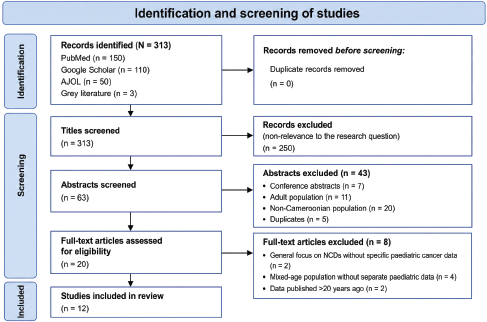
Figure 1. PRISMA 2020 flow diagram for selection of studies included in the review.
Characteristics of the selected studies
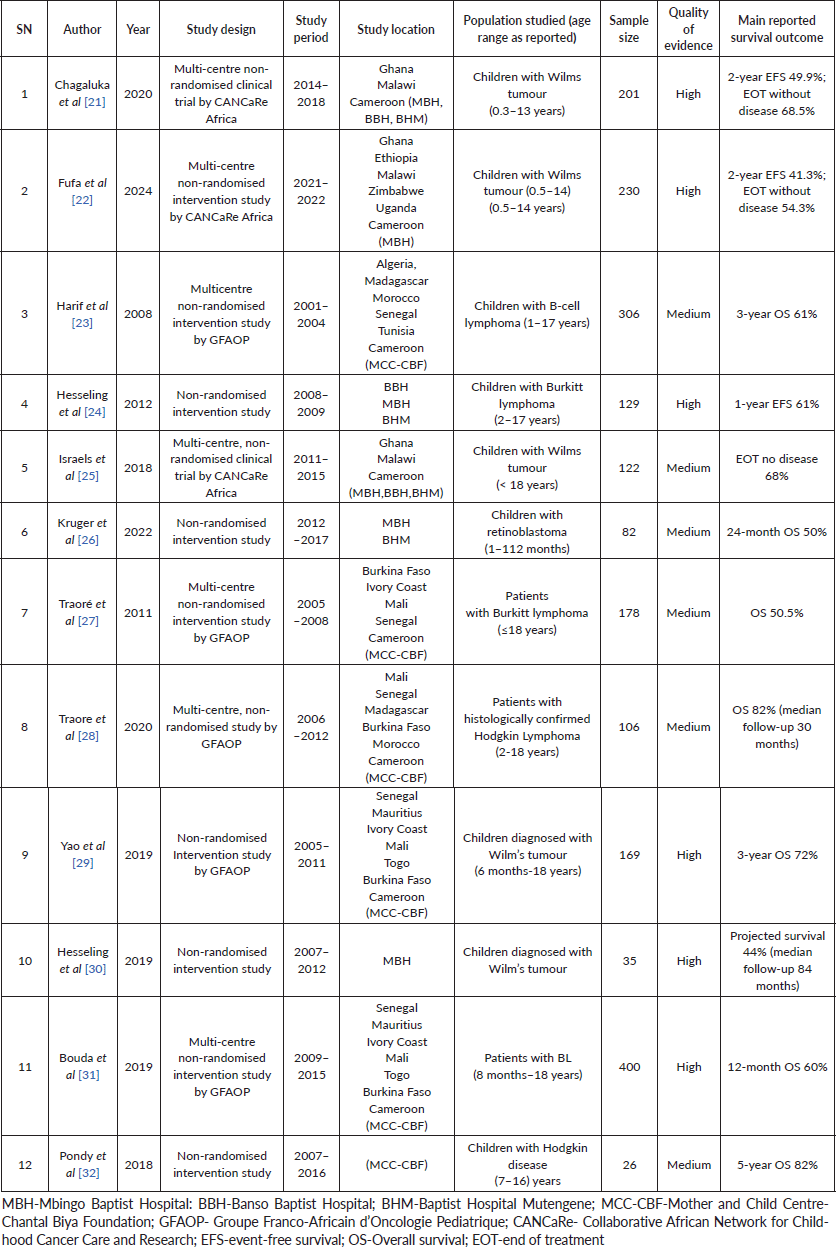
Four studies (33.3%) were conducted exclusively in Cameroon, whereas eight (66.7%) were multicentre studies undertaken through collaborative African initiatives, principally GFAOP and CANCaRe Africa, that included Cameroonian participants. A total of 1,984 children, aged 0–18 years, across all studies were included. Study periods spanned from 2001 to 2022. An equal number of studies were conducted within the CBCHS Childhood Cancer Program and the MCC-CBF. The most frequently studied malignancy was Wilms tumour (n = 5, 41.7%). Six studies were rated as high quality and six as medium quality based on ROBINS-I assessment. The characteristics of the 12 included studies are summarised in Table 1.
Treatment protocols
For Wilms tumour, all included studies reported the use of adaptations of the International Society of Paediatric Oncology (SIOP) protocols, which emphasise preoperative chemotherapy to reduce tumour size and surgical complications. Yao et al [29] employed the GFAOP-NEPHRO-02 protocol, an adapted version of SIOP2001, which combined vincristine and actinomycin, occasionally with doxorubicin, depending on stage. Similarly, Fufa et al [22] in the second CANCaRe study adapted protocols to local limitations but emphasised early surgery after preoperative chemotherapy. In the first CANCaRe Africa study, Chagaluka et al [21] used a consensus SIOP-adapted treatment guideline that also incorporated social support interventions to reduce treatment abandonment and avoided radiotherapy where unavailable.
For Burkitt lymphoma, three different protocols were used across the included studies. Two studies used regimens adapted by the GFAOP. Bouda et al [31] in the third GFAOP study implemented the adapted Groupe Franco-Africain (GF)-LMB2009 protocol, which involved intensified induction chemotherapy followed by reduced maintenance therapy, while Traoré et al [27] in the second GFAOP study employed cyclophosphamide monotherapy as first-line treatment and a multidrug second-line chemotherapy for refractory/relapsed patients. In contrast, Hesseling et al [24] applied the Cameroon 2008 Burkitt lymphoma protocol, which relied on a cyclophosphamide-based regimen with intrathecal chemotherapy.
Both studies on Hodgkin lymphoma used the COPP/ABV hybrid protocol without radiotherapy. For Retinoblastoma, the SIOP-paediatric oncology in developing countries (PODC) retinoblastoma guideline for Setting 1 was used. Two modified LMB89 regimens modified African treatment protocol (“MAT” and “GFA”) were applied in the study on B-cell lymphoma.
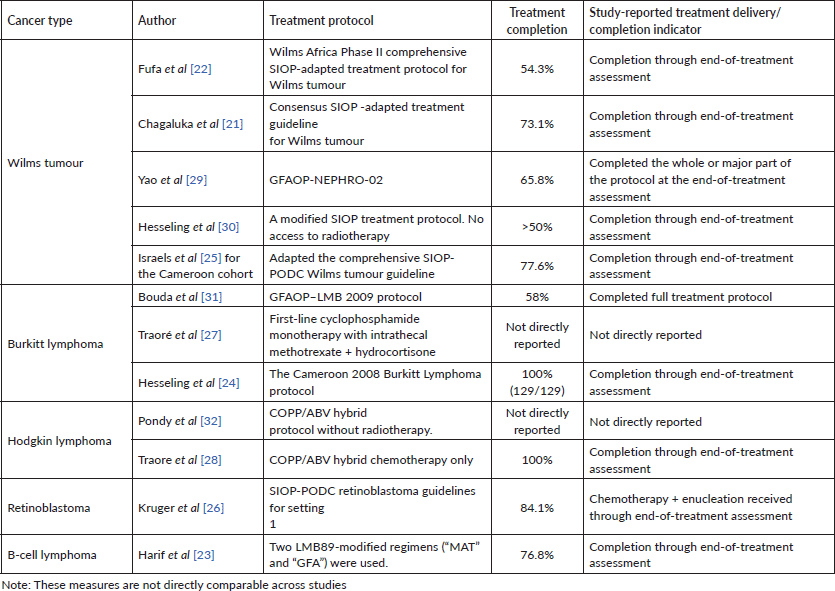
The reporting of treatment completion was inconsistent across studies. Some authors reported completion of the full protocol, while others reported completion through end-of-treatment assessment, and others did not directly report on this indicator. Because these measures were not directly comparable, the treatment completion rate was not pooled quantitatively. Instead, Table 2 summarises each protocol together with the closest study-reported treatment delivery or completion indicator.
Comparative findings and survival outcomes
Comparative analyses were performed for 10 of the 12 studies and fell into three main categories. Implementation-versus-baseline or time-based comparisons showed mixed findings. Chagaluka et al [21] reported an increase in end-of-treatment survival after the implementation of the adapted Wilms tumour protocol (OR = 2.05, 95% CI; 1.5–2.6), and Israels et al [25] also reported improved outcomes in the Cameroonian implementation cohort, although with imprecise estimates (OR = 2.07, 95% CI:0.61–7.11). In contrast, Fufa et al [22] reported lower survival in the second African Wilms cohort than in the earlier cohort (OR = 0.54, 95%CI; 0.37–0.81).
Stage-based comparisons consistently favoured earlier disease at presentation. Yao et al [29] and Hesseling et al [30] demonstrated better outcomes for children with Wilms tumour diagnosed at earlier stages (stages I and II) than for those with advanced disease (stages III and IV) (OR = 4.13, 95% CI; 1.90–8.99 and OR = 7.00, 95% CI; 1.39–35.34, respectively). A similar pattern was observed for Burkitt lymphoma in the Cameroon 2008 protocol study [24] and for Retinoblastoma [26], where early-stage disease had higher survival than advanced-stage disease (OR = 10.27, 95%CI; 3.21–32.81)
Table 1. Characteristics of studies included in the systematic review and meta-analysis.
Protocol-versus-protocol and protocol-evolution comparisons were less consistent. Bouda et al [31] reported higher survival for stage III Burkitt lymphoma in the third GFAOP study than in the first GFAOP cohort (OR = 1.92, 95% CI: 1.07–3.44), and Harif et al [23] found better outcomes in the MAT regimen than with the GFA regimen for B-cell lymphoma (OR = 2.48, 95% CI 1.49–4.12). By contrast, Traoré et al [27] found no statistically clear difference between first-line cyclophosphamide monotherapy and second-line multi-drug therapy (OR = 0.88, 95% CI; 0.50–1.58). For Hodgkin lymphoma, both Pondy et al [32] and Traore et al [28] reported high study-level survival using COPP/ABV hybrid regimens without radiotherapy, but comparative ORs were not estimable because favourable risk groups achieved 100%.
Across the included studies, survival was reported using different endpoints, including end-of-treatment status, event-free survival and overall survival. These measures were not treated as interchangeable. Accordingly, Table 3 presents study-specific comparative ORs as exploratory measures only, and these should be interpreted in the context of each study’s reported endpoint and comparator group.
Meta-analysis
An initial exploratory random-effects model across all study-specific comparative ORs showed substantial between-study heterogeneity (Q = 59.9, p < 0.0001; I² = 85%; τ² = 0.66), indicating marked variation in comparative estimates across studies. Because comparison groups differed across studies, we did not interpret this as a single pooled treatment effect. Instead, ORs were pooled exploratorily by comparator category.
Stage-based comparisons showed the largest pooled association (OR = 5.89, 95% CI: 3.38–10.29), whereas implementation/time-based comparisons (OR = 1.25, 95% CI: 0.43–3.59) and protocol-versus-protocol or protocol-evolution comparisons (OR = 1.63, 95% CI: 0.88–3.00) were smaller and less precise (Table 4). The two Hodgkin lymphoma studies were not included in the comparator-category pooled analysis because the favourable prognostic group had 100% survival in both studies, preventing reliable estimation of study-specific ORs for pooling.
Table 2. Treatment protocols by cancer type.
Sensitivity analysis
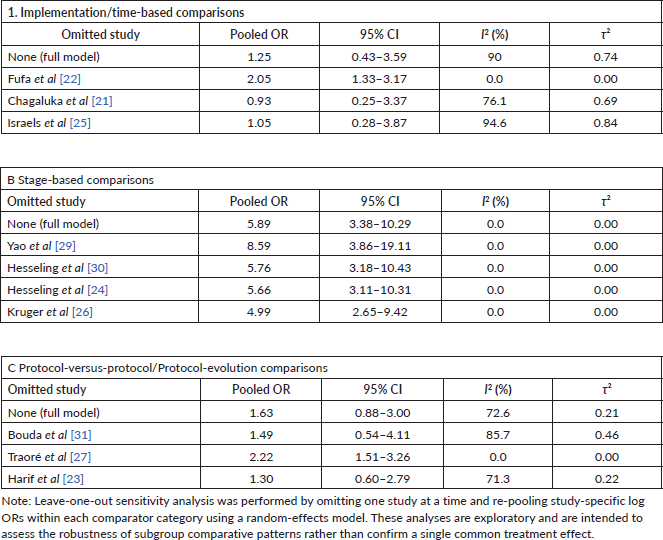
Leave-one-out sensitivity analysis showed that the stage-based subgroup was the most robust, with pooled ORs remaining consistently elevated after omission of each study in turn (OR range 4.99–8.59; I² = 0% throughout). In contrast, the implementation/time-based subgroup was less stable, with pooled ORs ranging from 0.93 to 2.05 and heterogeneity remaining high in most iterations. Excluding Fufa et al [22] increased the pooled OR and eliminated heterogeneity, whereas the exclusion of Chagaluka et al [21] or Israels et al [25] shifted the pooled estimate toward the null with persistent between-study variability. The protocol-versus-protocol or protocol-evolution subgroup was also sensitive to study omission, becoming statistically significant only after exclusion of Traoré et al [27]. Detailed results are presented in Table 5.
Table 3. Study-specific exploratory comparative ORs for reported outcomes, organized by cancer type and classified by comparator type and comparison group.
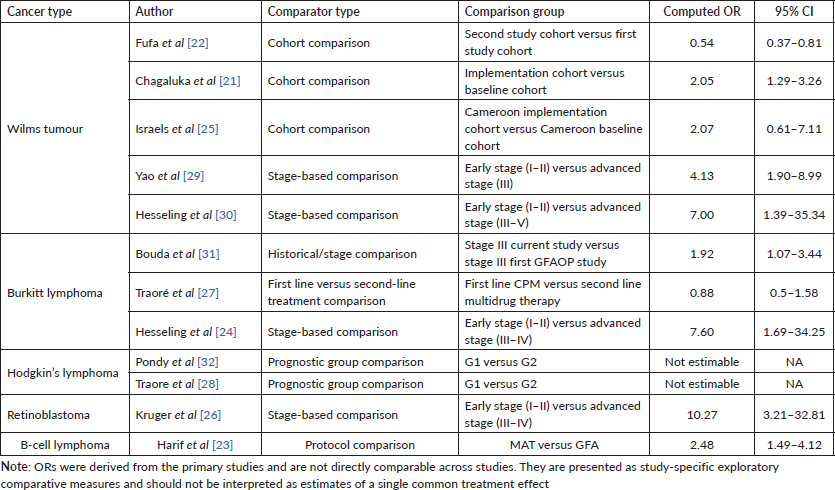
Table 4. Exploratory pooled ORs by comparator category.
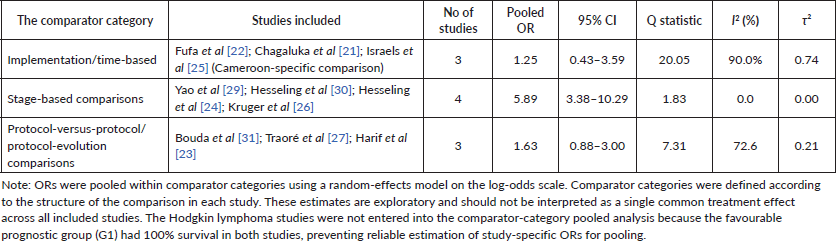
Table 5. Leave-one-out sensitivity analysis of exploratory pooled ORs by comparator category.
Discussion
This systematic review synthesised evidence on adapted paediatric cancer treatment protocols used in Cameroon and in collaborating Sub-Saharan African centres that included Cameroonian children. Overall, the reviewed studies suggest that adapted protocols can support encouraging outcomes for several childhood cancers in resource-limited settings. However, the evidence does not support a single pooled estimate of protocol effectiveness. The included studies differed not only in cancer type and study design but also in the outcomes reported and in the structure of comparisons used to derive comparative ORs. As a result, the findings are best interpreted as patterns across centres rather than as a single common treatment effect.
In Wilms tumour, the most frequently studied malignancy in this review, survival improvements were consistently associated with the implementation of adapted SIOP-based protocols. These protocols emphasise preoperative chemotherapy to reduce tumour size and surgical risk, an approach particularly well suited to settings where children often present with advanced disease [12,33–35]. Studies by Chagaluka et al [21] and Yao et al [29] demonstrated significant survival gains following protocol implementation, especially among children diagnosed at earlier stages. Similar patterns have been reported across Africa, reinforcing the suitability of SIOP-adapted protocols in resource-constrained contexts [12, 33, 34].
Burkitt lymphoma, the most common childhood cancer in sub-Saharan Africa [36, 37], was managed using a range of adapted regimens across the included studies. Earlier approaches, such as cyclophosphamide, were designed to maximise feasibility and reduce toxicity but were often associated with higher relapse rates [27, 38, 39]. More recent studies adopting intensified but still adapted regimens, including lymphomes malins B (LMB)-based protocols, have reported improved survival even among children with advanced-stage disease [24, 31]. The survival pattern for Burkitt lymphoma in this review aligns with outcomes reported from other LMICs [6, 11, 39] but remains substantially lower than survival achieved in HICs using high-intensity, risk-adapted protocols supported by robust infrastructure [4].
For Hodgkin lymphoma, both included studies used COPP/ABV hybrid regimens without radiotherapy and reported strong study-level survival [28, 32]. These findings are consistent with reports from other LMICs using similar chemotherapy-only approaches [40, 41]. Notably, survival reached 100% among children in favourable-risk groups, highlighting the curability of Hodgkin lymphoma even in the absence of radiotherapy when chemotherapy is delivered effectively, and the disease is treated early. A similar outcome was also reported by Baez et al [42] in Nicaragua. Nonetheless, outcomes remain inferior to those reported in HICs and in settings such as Egypt, where combined-modality therapy is more available [43–45].
The single study on retinoblastoma [26] included in this review demonstrated a strong survival advantage for children diagnosed at early stages (stages I–II). This finding reinforces the central role of early detection and timely intervention in determining outcomes for this malignancy, especially in SIOP-PODC setting 1 environments with only basic imaging, no radiotherapy, minimal pathology services, no genetic testing and no dedicated paediatric oncology ward [26, 46]. The study also highlights key barriers to early detection in Cameroon, noting late diagnosis (median age 24 months in contrast to 14.1 months in HICs) and the use of traditional/complementary medicine by more than 50% of families, which may delay diagnosis. Across LMICs, late presentation, refusal of enucleation and reliance on traditional medicine continue to contribute to poor outcomes (survival rates of 44%–57%), in contrast to HICs, where survival now exceeds 95% [47–50]. Together, these findings suggest that for Retinoblastoma in Cameroon and other LMICs, protocol adaptation is important, but survival is likely to depend just as much on awareness, timely referral, earlier entry into care and acceptance of enucleation where indicated.
The exploratory comparator-category analysis showed that stage-based comparisons consistently showed better outcomes among children presenting with earlier-stage disease than among those with advanced disease [24, 26, 29, 30], whereas implementation/time-based comparisons were smaller and much more heterogeneous. This suggests that the most consistent survival differences in the study are linked to how early children enter care, rather than to protocol adaptation alone.
A further issue highlighted by this review is the inconsistency in outcome reporting. Across studies, authors reported end-of-treatment status, event-free survival, projected survival or overall survival over different follow-up periods. These measures are related but not interchangeable, and this limits cross-study comparability. Future studies in this field would therefore be strengthened by harmonised reporting of end-of-treatment, event-free and overall survival outcomes.
Implication for policy and practice
Findings from this review suggest that survival gains in childhood cancer in Cameroon and collaborating sub-Saharan African centres are achievable when adapted treatment protocols are implemented within functional care pathways. Policy priorities should therefore extend beyond protocol modification alone to include: strengthening early diagnostic and referral systems; ensuring access to minimum supportive care packages, including essential medicines and blood products; integrating social supportive care mechanisms to reduce treatment abandonment; and harmonising national paediatric cancer treatment guidelines. Investments in these areas are likely to yield greater and more sustainable survival gains.
Limitations
This systematic review and meta-analysis has several limitations that should be considered when interpreting the findings. First, the included studies used non-randomised intervention designs, which are inherently subject to selection bias and unmeasured confounding. Although the use of the ROBINS-I tool enabled structured assessment of study quality, residual bias related to patient selection, disease severity and care-seeking behaviour cannot be fully excluded.
Secondly, there was substantial heterogeneity across studies in terms of cancer types, treatment protocols, comparator groups, follow-up duration and the structure of their comparisons. For this reason, the study-specific ORs and comparator-category pooled estimates should be interpreted as exploratory comparative measures rather than as estimates of a single common treatment effect.
Thirdly, reported outcomes were not uniform across studies. These measures are clinically related but not interchangeable, limiting direct comparability across studies and precluding the synthesis and interpretation of a single pooled survival estimate as a unified outcome.
Fourthly, formal assessment of publication bias (e.g., funnel plot asymmetry) was not performed because the limited number of included studies would render such analyses underpowered and their interpretation unreliable. As a result, the possibility that studies with negative or inconclusive findings are underrepresented cannot be entirely excluded.
Conclusion
Adapted paediatric cancer treatment protocols used in Cameroon and collaborating sub-Saharan African centres are associated with encouraging outcomes, but the available evidence is heterogeneous and should be interpreted cautiously. The most consistent finding was the strong survival advantage associated with earlier-stage disease, underscoring the importance of early diagnosis and standardised outcome reporting in future childhood cancer strategies.
Acknowledgment
Artificial intelligence-assisted tools were used to edit and refine the manuscript’s language and style. All scientific content, data interpretation, analyses and conclusions were developed, reviewed and approved by the authors, who take full responsibility for the accuracy and integrity of the work.
Conflicts of interest
The authors declare that they have no conflicts of interest.
Funding
This study did not receive any funding.
Ethical approval
This study was a systematic review of published literature and did not involve direct contact with human participants. Ethical approval was therefore not required in accordance with the Declaration of Helsinki.
Author contributions
Study conception and design: YW and GA; data extraction and quality assessment: YW, GA, FL, AP; analysis and interpretation of data: YW, GA, FL, AP, MB; drafting of manuscript: YW, GA, FL, AP, MB; final approval of version to be published: YW, GA, FL, AP, MB.
References
1. Ward ZJ, Yeh JM, and Bhakta N, et al (2019) Global childhood cancer survival estimates and priority-setting: a simulation-based analysis Lancet Oncol 20(7) 972–983 https://doi.org/10.1016/S1470-2045(19)30273-6 PMID: 31129029
2. Howard SC, Zaidi A, and Cao X, et al (2018) The My Child Matters Programme: effect of public-private partnerships on paediatric cancer care in low-income and middle-income countries Lancet Oncol 19(5) e252–e266 https://doi.org/10.1016/S1470-2045(18)30123-2 PMID: 29726390
3. Farrag A, Ghazaly MH, and Mohammed K, et al (2023) Comparing presentations and outcomes of children with cancer: a study between a lower-middle-income country and a high-income country BMC Pediatr 23 443 https://doi.org/10.1186/s12887-023-04214-8 PMID: 37670249 PMCID: 10478379
4. Kinsey SE and Picton SV (2021) Childhood cancer in high resource settings Cancer Epidemiology 71 101838 https://doi.org/10.1016/j.canep.2020.101838 PMID: 33495096
5. Gupta S, Howard SC, and Hunger SP, et al (2015) Treating childhood cancer in low- and middle-income countries [Internet] Cancer: Disease Control Priorities, Third Edition (Volume 3) eds H Gelband, P Jha, and R Sankaranarayanan, et al (Washington: The International Bank for Reconstruction and Development/The World Bank) p 3 [http://www.ncbi.nlm.nih.gov/books/NBK343626/]
6. Van Heerden J, Balagadde-Kambugu J, and Angom R, et al (2023) Evaluating the baseline survival outcomes of the “Six Global Initiative for Childhood Cancer index cancers” in Africa [Internet] Pediatr Hematol Oncol Internet 40(3) [https://pubmed.ncbi.nlm.nih.gov/36369884/] https://doi.org/10.1080/08880018.2022.2140860
7. Howard SC, Davidson A, and Luna-Fineman S, et al (2017) A framework to develop adapted treatment regimens to manage pediatric cancer in low- and middle-income countries: the Pediatric Oncology in Developing Countries Committee of the International Pediatric Oncology Society (SIOP) Pediatr Blood Cancer 64(S5) e26879 https://doi.org/10.1002/pbc.26879
8. Lemerle J, Barsaoui S, and Harif M, et al (2007) Treatment of childhood cancer in Africa. Action of the Franco-African childhood cancer group Med Trop Rev Corps Sante Colon 67(5) 497–504
9. Chitsike I, Paintsil V, and Sung L, et al (2020) Working together to build a better future for children with cancer in Africa JCO Glob Oncol 6(6) 1076–1108 https://doi.org/10.1200/GO.20.00170 PMID: 32673078 PMCID: 7392779
10. Hesseling P, Israels T, and Harif M, et al (2013) Practical recommendations for the management of children with Endemic Burkitt Lymphoma (BL) in a resource-limited setting Pediatr Blood Cancer 60(3) 357–362 https://doi.org/10.1002/pbc.24407
11. Ngoma T, Adde M, and Durosinmi M, et al (2012) Treatment of Burkitt lymphoma in equatorial Africa using a simple three-drug combination followed by a salvage regimen for patients with persistent or recurrent disease Br J Haematol 158(6) 749–762 https://doi.org/10.1111/j.1365-2141.2012.09236.x PMID: 22844968 PMCID: 3431556
12. Ekenze SO, Okafor OC, and Obasi AA, et al (2020) Wilms tumor in Africa: a systematic review of management challenges and outcome in two decades (2000-2019) Pediatr Blood Cancer 67(11) e28695 https://doi.org/10.1002/pbc.28695 PMID: 32909662
13. World Bank [Internet] Overview [https://www.worldbank.org/en/country/cameroon/overview]
14. Ortiz R WHO global initiative for childhood cancer countries engaged [https://siop-online.org/wp-content/uploads/2024/05/GICC-2024-Updated-Levels-of-Country-Engagement-V2.pdf]
15. MINSANTE (2020) National Strategic Plan for Prevention and Cancer Control 2020 - 2024.pdf [Internet] [https://www.iccp-portal.org/system/files/plans/FINAL%20COPY%20OF%20PSNPLCa%20ENGLISH.pdf]
16. Afungchwi GM, Kruger M, and Kouya F, et al (2021) Two decades of childhood cancer care in Cameroon: 2000–2020 [Internet] Pediatr Blood Cancer 68(7) 68 [10.1002/pbc.28997] https://doi.org/10.1002/pbc.28997
17. Cameroon Oncology Center [Internet] Cameroon Oncology Center; Radiation Oncology [https://www.camoncenter.org/index.php/about]
18. CureAll framework: WHO global initiative for childhood cancer [Internet] [https://www.who.int/publications/i/item/9789240025271]
19. Page MJ, McKenzie JE, and Bossuyt PM, et al (2021) The PRISMA 2020 statement: an updated guideline for reporting systematic reviews BMJ 372 71 https://doi.org/10.1136/bmj.n71
20. Sterne JA, Hernán MA, and Reeves BC, et al (2016) ROBINS-I: a tool for assessing risk of bias in non-randomised studies of interventions BMJ 355 4919 https://doi.org/10.1136/bmj.i4919
21. Chagaluka G, Paintsil V, and Renner L, et al (2020) Improvement of overall survival in the Collaborative Wilms Tumour Africa Project Pediatr Blood Cancer 67(9) e28383 https://doi.org/10.1002/pbc.28383
22. Fufa D, Mdoka C, and Ayalew M, et al Effectiveness of a Wilms tumour treatment guideline adapted to local circumstances in sub-Saharan Africa: a report from Wilms Africa Phase II—CANCaRe Africa Pediatr Blood Cancer e31300
23. Harif M, Barsaoui S, and Benchekroun S, et al (2008) Treatment of B-cell lymphoma with LMB modified protocols in Africa -- report of the French-African Pediatric Oncology Group (GFAOP) Pediatr Blood Cancer 50(6) 1138–1142 https://doi.org/10.1002/pbc.21452 PMID: 18213709
24. Hesseling PB, Njume E, and Kouya F, et al (2012) The Cameroon 2008 Burkitt lymphoma protocol: improved event-free survival with treatment adapted to disease stage and the response to induction therapy Pediatr Hematol Oncol 29(2) 119–129 https://doi.org/10.3109/08880018.2011.644881 PMID: 22376015
25. Israels T, Paintsil V, and Nyirenda D, et al (2018) Improved outcome at end of treatment in the collaborative Wilms tumour Africa project Pediatr Blood Cancer 65(5) e26945 https://doi.org/10.1002/pbc.26945
26. Kruger M, van Elsland SL, and Afungchwi GM, et al Outcome of retinoblastoma treatment protocol in Cameroon as per SIOP‐PODC recommendation for a low‐income setting [https://onlinelibrary.wiley.com/doi/10.1002/pbc.29642] https://doi.org/10.1002/pbc.29642
27. Traoré F, Coze C, and Atteby JJ, et al (2011) Cyclophosphamide monotherapy in children with Burkitt lymphoma: a study from the French-African Pediatric Oncology Group (GFAOP) Pediatr Blood Cancer 56(1) 70–76 https://doi.org/10.1002/pbc.22746
28. Traore F, Diagne Akonde FB, and Togo B, et al (2020) Treatment of childhood Hodgkin lymphoma in sub-Saharan Africa: a report from the French-African Paediatric Oncology Group (GFAOP) South Afr J Child Health 14(3) 155–160 https://doi.org/10.7196/SAJCH.2020.v14i3.01723
29. Yao AJJ, Moreira C, and Traoré F, et al (2019) Treatment of Wilms Tumor in Sub-Saharan Africa: results of the Second French African Pediatric Oncology Group Study J Glob Oncol 5(5) 1–8 PMID: 31487216 PMCID: 6872179
30. Hesseling PB, Bardin R, and Brown JA, et al (2019) Wilms tumour: long-term survival of patients treated at Mbingo Baptist Hospital in Cameroon between 2007 and 2012 South Afr J Oncol 3(0) 4
31. Bouda GC, Traoré F, and Couitchere L, et al (2019) Advanced Burkitt lymphoma in Sub-Saharan Africa pediatric units: results of the third prospective multicenter study of the Groupe Franco-Africain d’Oncologie Pédiatrique J Glob Oncol 5(5) 1–9
32. Hermine PA, Molom Rodrigue D, and Bernadette NN, et al (2018) Evaluation of the response to chemotherapy in the treatment of Hodgkin’s disease at the Mother and Child Center of the Chantal Biya’s Foundation in Yaounde, Cameroon Arch Cancer Res 6 https://doi.org/10.21767/2254-6081.100168
33. Bhatnagar S (2009) Management of Wilms’ tumor: NWTS vs SIOP J Indian Assoc Pediatr Surg 14(1) 6–14 https://doi.org/10.4103/0971-9261.54811
34. Madani A, Zafad S, and Harif M, et al (2006) Treatment of Wilms tumor according to SIOP 9 protocol in Casablanca, Morocco [Internet] Pediatr Blood Cancer 46(4) [https://pubmed.ncbi.nlm.nih.gov/16035094/] https://doi.org/10.1002/pbc.20436
35. Israels T, Moreira C, and Scanlan T, et al (2013) SIOP PODC: clinical guidelines for the management of children with Wilms tumour in a low-income setting Pediatr Blood Cancer 60(1) 5–11 https://doi.org/10.1002/pbc.24321
36. Stefan C, Bray F, and Ferlay J, et al (2017) Cancer of childhood in sub-Saharan Africa ecancermedicalscience 11 755 https://doi.org/10.3332/ecancer.2017.755
37. Stefan DC (2015) Patterns of distribution of childhood cancer in Africa J Trop Pediatr 61(3) 165–173 https://doi.org/10.1093/tropej/fmv005 PMID: 25724211
38. Hesseling PB, Molyneux E, and Tchintseme F, et al (2008) Treating Burkitt’s lymphoma in Malawi, Cameroon, and Ghana Lancet Oncol 9(6) 512–513 https://doi.org/10.1016/S1470-2045(08)70139-6
39. Ozuah NW, Lubega J, and Allen CE, et al (2020) Five decades of low intensity and low survival: adapting intensified regimens to cure pediatric Burkitt lymphoma in Africa Blood Adv 4(16) 4007–4019 https://doi.org/10.1182/bloodadvances.2020002178 PMID: 32841337 PMCID: 7448606
40. Sripada PV, Tenali SG, and Vasudevan M, et al (1995) Hybrid (COPP/ABV) therapy in childhood Hodgkin’s disease: a study of 53 cases during 1989-1993 at the Cancer Institute, Madras Pediatr Hematol Oncol 12(4) 333–341 https://doi.org/10.3109/08880019509029583
41. Klumb CE, Carriço MK, and de Rezende LMM, et al (2007) Long-term outcome of children and adolescents, treated with the COPP–ABV hybrid protocol for Hodgkin’s disease: balance of risks Clin Oncol 19(8) 628–629 https://doi.org/10.1016/j.clon.2007.06.010
42. Baez F, Ocampo E, and Conter V, et al (1997) Treatment of childhood Hodgkin’s disease with COPP or COPP-ABV (hybrid) without radiotherapy in Nicaragua Ann Oncol Off J Eur Soc Med Oncol 8(3) 247–250 https://doi.org/10.1023/A:1008200210674
43. Schellong G, Brämswig JH, and Hörnig-Franz I (1992) Treatment of children with Hodgkin’s disease--results of the German Pediatric Oncology Group Ann Oncol Off J Eur Soc Med Oncol 3(Suppl 4) 73–76 https://doi.org/10.1093/annonc/3.suppl_4.S73
44. Wolden SL, Chen L, and Kelly KM, et al (2012) Long-term results of CCG 5942: a randomized comparison of chemotherapy with and without radiotherapy for children with Hodgkin’s lymphoma—a report from the Children’s Oncology Group J Clin Oncol 30(26) 3174–3180 https://doi.org/10.1200/JCO.2011.41.1819 PMID: 22649136 PMCID: 3434976
45. Sherief LM, Elsafy UR, and Abdelkhalek ER, et al (2015) Hodgkin lymphoma in childhood Med (Baltimore) 94(15) 670 https://doi.org/10.1097/MD.0000000000000670
46. Chantada G, Luna-Fineman S, and Sitorus RS, et al (2013) SIOP-PODC recommendations for graduated-intensity treatment of retinoblastoma in developing countries Pediatr Blood Cancer 60(5) 719–727 https://doi.org/10.1002/pbc.24468 PMID: 23335388
47. Wong ES, Choy RW, and Zhang Y, et al (2022) Global retinoblastoma survival and globe preservation: a systematic review and meta-analysis of associations with socioeconomic and health-care factors Lancet Glob Health 10(3) e380–e389 https://doi.org/10.1016/S2214-109X(21)00555-6
48. Boubacar T, Fatou S, and Fousseyni T, et al (2010) A 30-month prospective study on the treatment of retinoblastoma in the Gabriel Toure Teaching Hospital, Bamako, Mali Br J Ophthalmol 94(4) 467–469 https://doi.org/10.1136/bjo.2009.159699
49. Kruger M, Reynders D, and Omar F, et al (2014) Retinoblastoma outcome at a single institution in South Africa South Afr Med J Suid-Afr Tydskr Vir Geneeskd 104(12) 859–863
50. Luna‐Fineman S, Barnoya M, and Bonilla M, et al (2012) Retinoblastoma in Central America: report from the Central American Association of Pediatric Hematology Oncology (AHOPCA) Pediatr Blood Cancer 58(4) 545–550 https://doi.org/10.1002/pbc.23307