Objectives: The objective of the article is to explore the surgical practices and views in the treatment of melanoma within members and non-members of the EORTC Melanoma Group (MG) during the years 2003–2005.
Methods: An e-mail questionnaire (see appendix) developed within the EORTC MG was sent to all melanoma units (MUs) of the EORTC (180) and to selected international centres between 2003 and 2005. The questionnaire investigated the different practices regarding surgical management of melanoma patients at all stages.
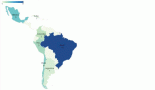
Results: A total of 75 questionnaires were returned from centres in Europe (70), Israel (3), Australia (1) and the United States (1). Resection margins on primary melanoma vary according to AJCC 2002 staging. Sixty three of 75 MUs perform Sentinel node biopsy. Modified radical neck dissection is performed in 82% of MUs for macrometastases and in 80% of MUs for micrometastases. Most MUs surveyed perform all three levels of Berg axillary dissection whether for macrometastases (79%) or micrometastases (62%). An ilio inguinal-obturator dissection is proposed with macrometastases (41% of MUs), whereas 33% of MUs perform a pelvic dissection only if the Cloquet node is positive. Twenty five of 75 MUs perform an isolated limb perfusion with a therapeutic indication; three also as an adjuvant. The majority of MUs perform surgery for distant metastases including superficial (53 of 75 [71%]) or solitary visceral metastases (52 of 75[69%]) or for palliation (58 of 75[77%]).
Conclusion: The adequacy of surgery appears to be the most important milestone in the therapeutic approach of melanoma. Even if surgery is fundamental in the different stages of the disease, there is quite a variability concerning the extension of the surgical treatment related to primary and lymphnodal disease. Phase III randomised trials have shown that wide margins, elective lymph node dissections, and prophylactic isolated limb perfusions have not improved survival and cannot be considered the standard of care in the routine management of primary melanoma. The surgical subgroup of the EORTC Melanoma Group is developing a new version of the surgical survey questionnaire including new treatment modalities like isolated limb infusion and electrochemotherapy, which were not frequently in use some years ago, to obtain new data to be compared to the nearly ten-year-old data.