Supporting oncology professionals through education
The content on this site is intended for healthcare professionals only
The content on this site is intended for healthcare professionals only
Soumen Das1, Retina Paul2, Tanmoy K Mandal1, Rahul Agarwal3, Akash Guha3, Anowar Ali Mallick4, D K Sarkar4
Institute of Breast Disease, NCRI Hospital, Kolkata, India
College of Medicine and JNM Medical College , Kalyani , India
Netaji Subhas Chandra Bose Cancer Hospital, Kolkata, India
IPGME&R, SSKM Hospital, Kolkata , India
Late-stage breast cancer diagnosis is a major cause of mortality in low- and middle-income countries (LMICs). With WHO’s target of achieving >60% early-stage diagnosis by 2030, there is a need for structured, low-cost clinical tools, as mammography screening remains largely inaccessible. The Breast Clinical Reporting and Data System (BC-RADS) was developed as a pragmatic, CBE-based scoring model to guide community-level early detection and referral pathways.
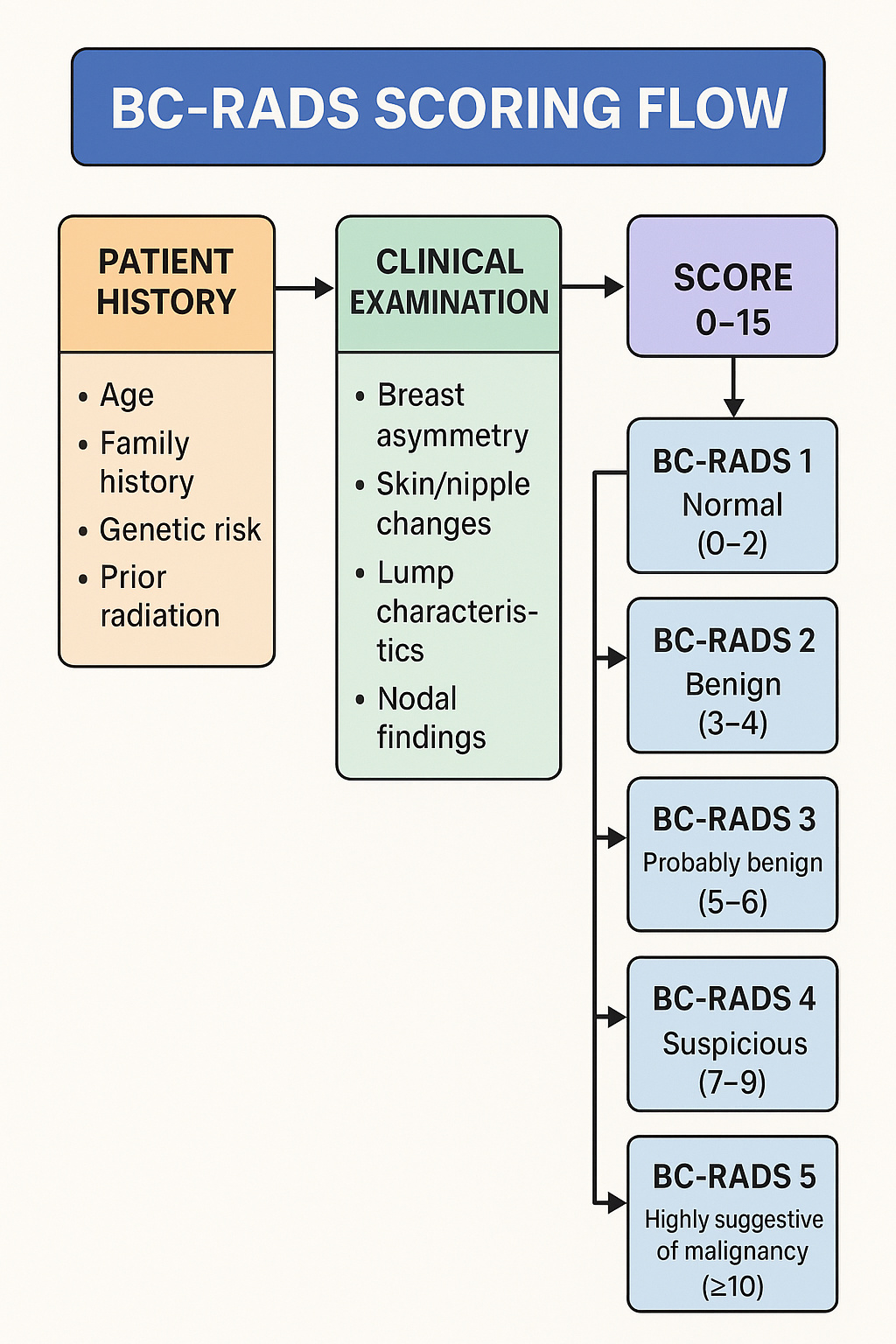
BC-RADS incorporates history (age, family history, genetic risk, prior radiation) and clinical examination parameters (breast asymmetry, skin/nipple changes, lump characteristics, nodal findings). Each component is scored to generate a 0–15 cumulative score categorized as ( Figure 1)
1. BC-RADS 1: Normal (0–2)
2. BC-RADS 2: Benign (3–4)
3. BC-RADS 3: Probably benign (5–6)
4. BC-RADS 4: Suspicious (7–9)
5. BC-RADS 5: Highly suggestive of malignancy (≥10)
A prospective validation was conducted among 240 women presenting to the Institute of Breast Disease, Kolkata (January–July 2025), including 142 breast cancer cases and 98 benign conditions. Predictive accuracy was assessed using sensitivity, specificity, and ROC analysis.
BC-RADS ≥7 (BC-RADS 4–5) was the optimal malignancy threshold, demonstrating:
Sensitivity: 93.2%
Specificity: 88.7%
AUC: 0.94 (95% CI: 0.91–0.96)
Among women scoring ≤4, unnecessary imaging/biopsy referrals were reduced by 42%. Community health workers trained through a short structured program achieved diagnostic accuracy comparable to trained clinicians.
BC-RADS is a low-cost, scalable clinical decision tool that strengthens early breast cancer detection in LMICs. Its integration at the primary care and community levels can reduce late-stage presentation, optimize referral pathways, and support national early-diagnosis goals.
Global Breast Cancer Initiative ( https://www.who.int/initiatives/global-breast-cancer-initiative)
Das S, Mondal RR, Basu A. Secondary and Quaternary Delays in the Diagnosis of Breast Cancer: Are the Physicians Responsible too? Indian J Surg Oncol. 2022 Sep;13(3):587-593. doi: 10.1007/s13193-022-01527-5. Epub 2022 Mar 2. PMID: 36187517; PMCID: PMC9515288.
Figure 1: BC-RAD Scoring