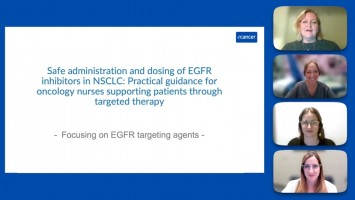
1: Safe administration and dosing of EGFR inhibitors in NSCLC - Practical guidance for oncology nurses
8 Jun 2026

The content on this site is intended for healthcare professionals only
Teresa Knoop speaks to ecancer at ONS 2019 about how the use of PARP inhibitors has changed.
She explains that clinical trials have so far indicated that PARP inhibitors may be more promising in treating breast and ovarian cancers with BRCA gene mutations.
Teresa concludes by saying that more research is needed to discover if PARP inhibitors are useful in treating cancers without known mutations or to discover potential combination strategies.
This programme has been supported by an unrestricted educational grant from Pfizer.
PARP is an enzyme that actually helps our cells repair DNA damage. So, as we know, many of our cancer cells are very prone to DNA damage and you actually don’t want those cells to repair themselves. So by targeting the PARP enzyme these PARP inhibitors, which are small molecules, these PARP inhibitors can actually prevent that from happening, prevent that cancer cell from repairing its DNA. Now, two of the really most promising areas in which we use PARP inhibitors are breast cancer and ovarian cancer and both of those cancers are more of our BRCA mutated related cancers. So that’s where the clinical trials have indicated that PARP inhibitors may be more useful and effective. Many, I think there are about four PARP inhibitors approved currently and of those PARP inhibitors most of them require a known mutation. However, I know that they’re also looking at the fact that because they can prevent the repair of the DNA damage then it might be useful in those cancers even if they’re not, if we do not have known mutations.
There’s a lot of information we still need to know about how to use the PARP inhibitors in the best way and to use them alone, to use them in combination, to use them with radiation. How is the best way we can utilise the PARP inhibitors to the patient’s best advantage?
1: Safe administration and dosing of EGFR inhibitors in NSCLC - Practical guidance for oncology nurses
Made to measure: Choosing the optimal regimen in transplant-eligible NDMM

Guiding transplant decisions in multiple myeloma with MRD

ESMO and WCLC: Latest developments in EGFR mutated NSCLC

Cabozantinib demonstrates significant improvement in PFS by BICR in advanced neuroendocrine tumours

New NK-1 inhibitor HR20013 shows promising results in preventing chemotherapy-induced nausea and vomiting in NSCLC patients

Tusamitamab ravtansine versus docetaxel in previously treated advanced nonsquamous NSCLC: Results from phase 3 CARMEN-LC03 trial

Adagrasib shows durable clinical benefit in advanced KRAS-mutant NSCLC

OncoAlert Round Up for August 4th - 10th, 2023
