1: Safe administration and dosing of EGFR inhibitors in NSCLC - Practical guidance for oncology nurses
8 Jun 2026

The content on this site is intended for healthcare professionals only
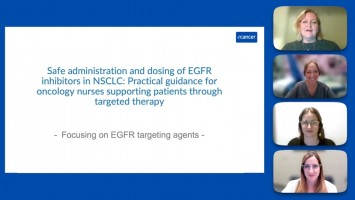
Helena Ullgren (Clinical Nurse Leader, Karolinska Institute, Sweden), Elin Backman Stålnacke (Oncology Contact Nurse, Karolinska Institute, Sweden), Rachel Powell (Advanced Clinical Practitioner, Haematology & Oncology, University Hospitals Birmingham NHS Foundation Trust, UK) and Patrick Jahn (University Hospital Halle, Halle, Germany) discuss managing EGFR inhibitor side effects in NSCLC.
This session focuses on the toxicity profile of EGFR-targeted therapies in non-small cell lung cancer (NSCLC), with a strong emphasis on skin-related adverse events and their broader impact on patients.
Experts highlight that dermatologic toxicities (rash, paronychia, fissures) are the most common and often the most distressing side effects. While not always clinically severe, these visible symptoms can significantly affect quality of life, body image, and psychosocial well-being, sometimes leading patients to pause or reduce treatment, impacting adherence.
The discussion also explores reactive management approaches, including topical treatments and collaboration with dermatology specialists, while noting that systemic corticosteroids are rarely required. Emerging evidence supports proactive regimens, reinforcing the importance of early intervention before toxicities worsen.
Beyond skin-related effects, the panel addresses other clinically relevant toxicities, including ocular issues, cardiac events, interstitial lung disease, and mucositis, which can be complex to assess, particularly in patients with pre-existing comorbidities.
A central theme is the importance of individualised, patient-centered care, recognising that toxicity impact goes beyond clinical grading and can significantly affect daily functioning, emotional well-being, and adherence.
The discussion concludes by highlighting the evolving role of digital health tools and remote monitoring, enabling closer follow-up, earlier intervention, and stronger nurse–patient communication.
Overall, this discussion reinforces that proactive management, multidisciplinary collaboration, and continuous patient engagement are critical to optimizing outcomes with EGFR-targeted therapies in NSCLC.
| Common side effects of EGFR targeting agents | |
| The physical impact of skin toxicities and its management | |
| Timing and prevention of EGFR related skin toxicities | |
| Proactive and reactive management | |
| Management of other adverse events associated with EGFR/MET inhibition | |
| Follow up recommendations |
Managing EGFR Inhibitor Side Effects in NSCLC: Prophylaxis, Symptom Control, Patient Communication, and Effective Follow-Up for Oncology Nurses
Helena Ullgren - Clinical Nurse Leader, Karolinska Institute, Sweden
Rachel Powell - Advanced Clinical Practitioner, Haematology & Oncology, University Hospitals Birmingham NHS Foundation Trust, UK
Patrick Jahn - Martin Luther University of Halle-Wittenberg, Germany
Elin Backman Stålnacke - Oncology Contact Nurse, Karolinska Institute, Sweden
HU: Hello and welcome to this second session regarding toxicity and the management of EGFR-targeting agents in non-small cell lung cancer. This session will be mainly about side effects and toxicity and nursing management and what we can do to support our patients. We will focus on skin toxicity but we will also talk in general about other types of toxicity that we think are important to acknowledge. With me today I have a very good panel. Firstly I want to introduce one of my colleagues, Rachel Powell. She’s an Advanced Clinical Practitioner in Haematology and Oncology and she works in University Hospitals Birmingham NHS Foundation Trust in the UK. Then I have Elin Backman Stålnacke, she’s an Oncology Nurse and she works in Karolinska Comprehensive Cancer Center in Sweden. Last but not least I have Patrick Jahn, he’s a nurse and a Professor for Health Service at the University Medicine of Halle in Germany. So welcome everyone. Firstly, this first slide is mainly just to point into the topic of what the side effects are. So I think this is more for you to get an overview and then I will move on and we will go through some of these. But, as you can see, it’s a very wide spread of toxicity. Some of these are quite unusual but absolutely most common and the side effect that I would say from my experience is mostly burdensome to our patients would be the dermatological adverse events. I don’t know if anyone of you would like to say anything on this but I think the skin toxicity is usually what bothers our patients the most. I’m not sure what you think in the panel, anyone?
EBS: Yes, it’s the most common side effect and it’s very visible and many patients have a negative impact on their quality of life from these side effects.
RP: I’d agree, I think a lot of the time the other side effects we can manage a lot of the time with things like loperamide. We do have a few of our patients that do get a bit of GI disorders at times but sometimes I think that patients feel that they’re wearing a very visible sign of their cancer when they’re having EGFR treatments and whatever we can do to try and help to manage that. We do do a lot of counselling around the skin toxicities of EGFR-targeting agents, simply because we know that at some points a rash will occur and that can sometimes be quite widespread or sometimes it can be especially problems with their fingers and toes.
PJ: Yes, I think many things are already said and the visibility of these side effects is very burdensome because with other sites of cancer but this is a very prominent signal to the others that something is happening. I think that’s why it’s also important that we get preventive measures on this and on all these. The skin is a very large organ, so everything is infected. In terms of not feeling well, wearing clothes and all these things, and it’s very prominent for our nursing because we are very much in touch with them by washing and preparing them. So it’s also an important issue that the patient shares with us because we are so much connected in this touchy situation. Helena, I agree.
HU: Yes, and we already said that and if you look at the literature, like we all said, this is extremely common. I think you touched upon this with the psychological impact because I found myself sometimes, and maybe this is just me, but I certainly have learned since I started working with patients with EGFR treatments that the psychosocial impact is sometimes more large than we think because actually people can ask them what’s going on, they have a changed appearance. But I’m not sure if any one of you have anything to share on that? Something from your experience? But even a grade 2 sometimes for some patients could be more distressful than we think as healthcare professionals.
RP: I think especially with our EGFR-targeting agents in the non-small cell lung cancer setting, a lot of those patients are never smoking patients and there’s also the psychosocial impact of having a lung cancer that’s non-smoking related which can be a bolt out of the blue for a lot of these patients, they’re often quite young as well and might be still socially quite active. Now there’s this new, very visible, response to the treatment that they’re having as well, I think sometimes it’s not necessarily that people are judging them, it may very well just be that they feel that people might be judging them simply for having a lung cancer, potentially or having that skin toxicity as well. A lot of my patients have explained that they feel like their skin looks dirty and that’s really tricky because it’s not, it’s a reaction to their treatment.
HU: Yes, I recognise that a little bit, Rachel, actually, that you don’t feel clean and it’s always something that’s uncomfortable in a way. That’s what I heard from someone recently.
EBS: Also it’s quite hard to hide because it’s often in your face or on your chest and if you meet someone that maybe you don’t see everyday, the neighbours, it’s a very visual change that you can get questions about.
HU: I was also thinking because some of these are oral treatments. So we spoke a little bit in the first session on the administration route but could you see a link here? I know this is a slightly leading question but could you see a link between the patient taking this at home themselves and then also the skin toxicity, a potential risk here in terms of compliance?
RP: I have certainly experienced circumstances where patients have paused their treatment due to a skin toxicity, they just wanted to allow time for their skin to settle down and start back up again or even self-reduce dose reductions and things like that. There’s also the physical impact of the skin toxicities, when you’ve seen patients that have got paronychia, they’ve got these horrible fungal toe infections and things like that. Actually applying shoes, wearing shoes, and they don’t want to wear open-toed shoes in the summer because they’ve got these horrible fungal nail infections that they feel are unsightly as well. But actually having air to them and allowing it to dry out is sometimes the best option for them. So it is a bit of a vicious circle really, there’s that functionality perspective of their treatment. So I have seen quite a few patients that have actually stopped their treatment for a few weeks while they’ve wanted to allow for their toxicities to settle down.
HU: Yes, thank you, I recognise that too. Anyone else commenting on this, the impact of this toxicity?
PJ: Yes, maybe also a connection not only to the adherence to the primary medical tumour therapy but also the connection due to that they are not feeling well, maybe they are afraid to sweat and doing sport because from my side we are also finding that additional physical activity is very beneficial for them. So we have also these interactive measures with they are not using their mobility or going out or doing sports activities, although that would be very beneficial to have these side therapy effects. So this is another interference I see where this skin toxicity is reducing the adherence to these sportive measures.
HU: That’s a very important point and I think the point I’m getting from all of you here is that it does impact more than you would think from just looking at it sometimes. So if we move on to a little bit, the timing. This is basically what the literature says, that the skin acne-like rash and the really acute skin reaction usually comes quite quickly, I think we can recognise this. Then you have the paronychia a little bit later and fissures. I think also I’ve seen a few patients it comes up and down a little bit in this rash. I’m not sure if you recognise that but I also thought even if it’s hard to explain when they’re better but it’s comforting as well that you can say maybe that it can go up and down, do you know what I mean? When they’re really at their worst without them doing anything to the dose or something like that. But do you have any experience on this with the timing that you would like to talk about?
EBS: Yes, I usually tell my patients that this can occur quite quick after starting on treatment and I talk a lot about what they can do for themselves to prevent this in some degree. And also that they need to stick with it and just do the self-care and call me or their nurse if they get side effects so we can put in treatment if it’s necessary. Just, as you said Helena, to say that this is something that is usually worse the first month and then it can go up and down but that there’s a lot that we can do.
RP: Yes, I’ve definitely found the rash to be quite transient in nature. We do ebbs and flows, as I explain it, and there are going to be times when it’s a little bit worse. I think we, as nurses, are quite good at being accessible to our patients, I’d like to think, but also some of that up-front, like you say Elin, that self-care that we can put in place for our patients, I think that’s a really important part because it also means for the patient that they can take a little bit of ownership of their care as well. Having that control for the patient is really, really important at that stage of their treatment, having some control over part of their treatment. So when we talk about moisturising and not using a slap-dash approach to their moisturising regime and really taking that time to almost massage the creams into their face and things like that. So just having that little bit of ownership of their treatment as well can really help patients.
HU: I have seen, it’s a little bit connected to the timing. I’ve seen also a few patients that they cope with the first reaction quite well but then a bit further on, a few months on, when the fissures and the paronychia came, it was harder for them. So it’s also a kind of message to us as nurses, maybe, that we need to really tailor the follow-up of these patients. Just because they’ve been on it for a few months it doesn’t mean it’s easier for them in a way, if you understand my point. So I guess the timing is something a little bit different from other treatments in this setting that we might need to consider a bit more clearly. I certainly have missed to reinforce the message a bit later on when they start to have less rash and more other things. So, yes. But if we go on to… because you have started talking about what we can do with the moisturising and things like that. So this is just a little bit on the prevention – what do you recognise from this from your practice? Is this in line with how you would advise the patients?
EBS: Yes, that’s the exact, pretty much, advice we give our patients, both in writing and when we speak to them before they start treatment. This is the things we try to reinforce because we usually call them a few weeks in when they have been taking the oral or the intravenous. So we try to reinforce this several times. Because it’s easy to forget and, especially as you said, Helena, if you had the treatment for a long time you might stop using the moisturiser as often or you lose the habit. So it’s important to reinforce.
HU: Anything else that you do, any one of you, in prevention?
RP: Some of our EGFR treatments, knowing that there are some agents that are more likely to cause a lot of skin toxicity, those patients we will actually have them on a prophylactic oral tetracycline. So that’s managed from the start. We have some really good emollients that we use to use instead of a face wash or shower gel that they can use. We do talk about the importance of that daily moisturising. I sometimes think that we don’t give that sun exposure element of it the nod that we really should do, especially in the UK because we don’t see a lot of sun. Often when you’re talking to patients about excessive sun exposure you’re telling them that tongue in cheek really. But explaining about that sun exposure and I don’t sometimes think that we explain that as much as maybe we should do to patients. I think that’s definitely something that I’ve noticed in practice.
PJ: Actually nothing to add, what you recommended is pretty much in alignment of the ESMO guidelines, what is cited here. So that’s the evidence-based or the evidence behind; actually it’s also our focus in our institution .
HU: I just want to mention, because it’s not here, that what you said, Rachel, with using… starting almost from scratch with the prophylactic antibiotics, I do think it’s getting more and more common and I do think it helps many patients that it doesn’t get that inflamed. But of course we have side effects from that too. And I also have seen that the recommendation of really using a sunscreen, not only being avoiding exposure, it’s something that comes in guidelines now as well, it wasn’t before. So clearly. But this is more when you come into the management, we spoke about this with oral antibiotics, but we agreed that it also has a place, almost a prophylactic, when you start with that early. How do you use the systemic corticosteroids? Because I do know that even though it’s in the guidelines it’s not used everywhere. What is your take on that? Any advice or experience?
RP: Honestly, I haven’t ever had to use systemic corticosteroids for skin toxicity. On occasion, I guess we tend to use this maybe if all other measures have failed that we might look at giving topical steroids. Our dermatology colleagues are actually more likely to initiate topical steroids earlier than actually we will in oncology, which is quite interesting really. I think oncology nurses are very nervous about the idea of initiating topical steroids because we know about that skin thinning and we potentially don’t want to make things worse but actually, as I say, the derm team are quite quick to add them into the mix if they need to.
EBS: Usually I think then maybe we are quicker at using topical steroids, because it’s one of the first things we usually try.
HU: But I think we all can agree that systemic corticosteroids is not that common in this topic. When I read up on this again and thought to myself also because we use it so much anyway in those patients, on and off, for maybe other reasons. But I think that we didn’t mention so much but everything we do here is also aimed to not having to interrupt, isn’t it, the treatment a little bit. But definitely a dose reduction can be needed, of course. I was thinking about this, we will talk about it a little bit more in the third session about the multidisciplinary approach but definitely it’s very, very helpful when you have a good dermatologist team that have seen those patients. It’s not automatic just because you are working in dermatology that you know about those specific side effects. But I would say that those times I’ve used and we refer to them, it’s quite good. But anyway, we will move on to this. We kind of talked about the proactive management, we talked about the reactive management. So something we didn’t really mention was this with protecting hands and feet. What would your advice be to someone with paronychia and fissures? Would you talk to them about having gloves when they do the dishes or what is your approach to those things with your patients?
RP: I tend to advise no harsh chemicals. So, yes, definitely get a pair of Marigolds for the dishwashing and some good, decent gardening gloves as well because we have quite a lot of green-fingered patients as well. The other thing I tend to advise my patients is we give a chlorhexidine scrub, 4% scrub, that they can just do foot soaks a few times a week just to keep any infections out of any fissures that they might have. Actually they can use the chlorhexidine scrub for washing their hands in as well, just to keep any infections from their fingernails too. Often with our patients we do find we end up swabbing paronychia-infected fingers and toenails and very sore ones as well. I also advise them to use zinc oxide rich creams or pastes. Incidentally, there are some really good nappy creams that you can use that actually are quite zinc oxide rich. So that’s quite helpful, the only problem is that they find that it gets on everything because it’s a white substance so maybe applying it at night time and then some light cotton gloves just to protect this cream from getting all over their bedding and their face and all sorts of things like that. So I think a lot of our patients find that quite useful too.
HU: It’s interesting you say about the chlorhexidine soak because I don’t think, for example, we use that so much, Elin, in Sweden, do we?
EBS: No, not preventive. We’ve started using it a bit as a treatment when the patients have…
HU: Yes, a reactive response, yes.
EBS: Yes, reactive than preventive. But it might be something that we need to look more at.
HU: I was going to say because I wanted to just point, the COCOON study actually talks about the prophylactic and proactive management in everything you mentioned. The only thing that seems to be not used by everyone is the chlorhexidine. In this study they had that as one of the preventive measures as well. So the way I understood the study it was chlorhexidine like a soak or something. So that’s a bit interesting and I think even though we all already know that proactive is really important, that this study is quite new and it actually really supports that. So maybe that’s something to take with us and a message to our viewers that this is something we should do more of. Because the paronychia is not that easy to get rid of once you have an infection there. I don’t know what you guys think but I found it quite difficult sometimes when they have a full-blown infection in the finger or toe?
RP: When we swab the fingers and toes I always tend to find that they tend to be more fungal infections in the toes whereas in the fingers it’s more bacterial. I guess that’s having feet in shoes and things like that that might be more of an issue. So when we’re swabbing just making sure that we are swabbing and asking for a full fungal and bacterial screen as well is always quite useful, just so we know exactly what we’re trying to treat and we’re not trying to treat something for the wrong thing. Like I say, I’ve found that since using the chlorhexidine scrub, it’s very much what surgeons might use for scrubbing in to an operation, it’s the same sort of thing, and we just find that it does seem to limit the amount of infections that we get with our patients in their toes and fingers. As I say, it’s just a foot soak three times a week that we advise them to do. Obviously it can dry out the skin so we also advise them to moisturise thoroughly afterwards as well.
HU: Thank you for that and then you’re spot on what the evidence says also, Rachel, in your team, so that’s good. Anyone else, do you think we have missed anything on the proactive or reactive treatments? I think we covered quite a few things or anything anyone wants to add?
EBS: No, I think we covered most of what we advise our patients but it’s just that you need to help the patient to fit it into everyday life. Like how will I moisturise twice a day? How will I remember? How will I perform this self care?
HU: Yes, I agree, especially I’m not going to say anything because you’re here, Patrick, but I’ve had a few men that they have never moisturised before and they weren’t that keen to start. So it’s something that might be a barrier to… yes.
PJ: Yes, and I followed the discussion and Rachel’s shares on using chlorhexidine and the dermal secondary prevention, it can’t prevent rash but it can prevent all the other things. Maybe I’ll build on this. I think we’re waiting for these new results and I think this might change also these regimes to these preventive of secondary infections. Very good.
HU: So we have spoken mostly about the skin toxicity now but we do have other toxicity. When you look at this slide it’s about cardiac toxicity, ocular, neutropenia, interstitial lung disease of course, and oedema, stomatitis, mucositis, whatever you would, inflammation in the mouth. Some of these can be really serious but, to me, for example, ocular toxicity is not that easy and it can be really bothersome for the patients when they have either dry or it’s a lot of tears and then the eyelid can be really inflamed. I don’t know if you’ve seen that or what your take on this would be from your perspective?
RP: So because EGFR treatments make hair and especially eyelashes grow quite curly, can’t they, so they’re more likely to get ingrown eyelashes and that can be quite a tricky one to manage. With a lot of these patients I advise them to bathe the area with a bit of cooled boiled water or sometimes we’re able to get a bit of saline pod, cooled boiled water and a simple pad of cotton wool just to wipe the eye gently and obviously just to avoid reinfection from one eye to the other because that can also be a tricky thing. But a lot of our patients are on various eyedrops, Hypromellose type eyedrops, to help out with that dry eye symptoms. Ensuring that they’re wearing the right prescription glasses and things and regularly wearing them when they should be wearing them as well. Because, again, that can really dry out the eyes if the eyes are having to do a lot more work as well. But, yes, just bathing them. But if need be then we do have a rather help ophthalmology department upstairs so proximity-wise we’re quite lucky there.
HU: Anyone else on the ocular or any of these that I mentioned that you find tricky or challenging or hard to discover, assess, something?
PJ: No, but what is more in focus now is the cardiologic adverse events because the fear is with also maybe a prior cardiac disease. I think it also needs to be part of the essential assessment and needs to be followed up. It could be interfering also with all these other functional things, we try to keep patients active as well, so cardiologic adverse events have an interference with this. And then they have many questions about this and we need to follow up these measures. And oral mucositis is also still quite problematic and patients fear it. If they face it, very disturbing, particularly with more nutrition things.
HU: I think you touched upon a very important point there, that many of the patients with non-small cell lung cancer do have quite a lot of comorbidity. Not everyone but it’s not unusual, even though this group might not be smokers. They could have things from before, cardiac problems, but I find also the interstitial lung disease sometimes a bit tricky if they already have some dyspnoea. I don’t know about you but it’s not that easy to differentiate what it is. You always think about pulmonary embolism and things like that as well but even though it’s not that common, I sometimes think we think about other things before we think about this. I’m not sure what your experience is? Have you had anyone with lung…?
RP: Yes, I agree, especially when you’ve got a breathless patient, a patient that’s presenting breathless. And obviously we’re advising patients to report any new breathlessness but, again, when you’re looking at that differential diagnosis, is it a progression of their disease, is it interstitial lung disease? Is there a new pneumonitis caused by the treatment? Again, is that an issue? Again, pulmonary embolism like you mentioned, but then also those cardiac AEs can also cause that breathlessness as well or that chest tightness. So it can be a really tricky one to work out. We do have patients, we do three-monthly cardiac monitoring for our patients on EGFR treatment because we did have a patient unfortunately that developed a pericardial effusion. And he contacted us breathless, the first thing we thought was is it a progression of disease or is it potentially a new pneumonitis? But actually, no, it was more of a cardiac nature. So really getting patients to contact us and report those new symptoms as soon as possible but also being able to work out which of the organs we might be causing a bit of a problem with.
HU: Yes, and the takeaway on this slide is also that as the nurse you have a really important role because you follow the patient. So I think we usually catch any changes in that a bit earlier. I also think we are aware of the fact that most patients get really scared and think it’s their disease and then that’s no reason for them not putting this forward and showing us this. Because some of them, I think, also underreport when you feel worse because you’re scared. So that’s something, I think it’s tricky with some of those cardiac and lung toxicities.
PJ: Rachel pointed this out, very good, how complicated and how all this sorting out the things the patient could be. So it needs a good alignment to the patient and also a direct connection must be assured, that they’re reporting to us and then we can sort out if this really progresses or if this comes to another adverse event or it’s just maybe not very important, and not feeling well to a transition. Then that it could be also points to where the role of nursing is here very essential.
HU: Yes, I really think so. So we’re starting to wrap up a little bit here but also we spoke a lot about what to do proactively, we spoke about… As I say, being proactive, we more and more learn, at least me, that being a little bit more proactive rather than reactive is the key for the patients to cope and to adhere also to the treatment if it’s oral treatment and so on. In terms of follow-up we used to have a really standardised schedule when all those things were new but I find that you have to be really flexible and some patients you need to book maybe phone appointments, at least, or something very person-centred and flexible. So something we didn’t talk about so much but was this with all our self-care advice, the challenge around that. Because we can spot out so many advice but can the patient follow this? I don’t know if anyone wants to reflect because I think that’s also something that’s challenging for us as a nurse.
RP: I do think some people have a bit more of a slapdash approach, as I mentioned earlier, to their skincare. While I would not want to cast any aspersions on which patient group that is, I think we know that there are groups of patients that are less used to that skincare. Their skincare thus far throughout their however many years of life has been a bit of an all over with the same shower gel that they wash their hair in and everything else. Whereas we do have some of our patients that are more finite with their skincare and might use some slightly gentler products and things. So, yes, it’s just not making any assumptions and just ensuring that patients are very aware that they need to really take some time to massage moisturisers in and sometimes keeping them in the fridge quite helpful because it just has a cooling effect on their skin as well.
HU: Keeping it in the fridge, that’s a life hack as young people would say. It keeps it nice when you use it. But I think it’s all about being person centred, right? When you advise them and you follow up. Like we also touched upon, the timing of toxicity could challenge us, we might have to have more intense follow-up after a while with some patients. I guess if I’m going to summarise, now we come towards the end here, it’s that we need to not only grade these symptoms and side effects, we need to ask ourselves and the patient how much distress and interference with daily life this gives the patient. Because I know Patrick mentioned this a few times, that a very active patient could be sometimes more distressed by this because you get more inhibited in everything you want to do. So this is something, a message from me that I learned, that the grading is not enough when you assess and manage these patients. But if anyone wants to have any last comment feel free. No?
EBS: No, I just want to say also that it’s nice that now we have these digital tools with distance monitoring, the patient can send us pictures, we can see them on video if we can’t see them in person. I find that very helpful in assessing the rash and how it’s progressing or how the self-care advice is.
PJ: That’s perfect, I would also mention the same thing. We need to have a direct wire and it could be also to the wire where we get impressions about this and then it’s this really close relationship we all said is essential to provide patient-centred care, it needs this direct wire otherwise patients have a very long distance to come to us and have this exchange. So this is really an advantage and also a challenge in practice to keep this channel open.
HU: Yes, but I’m glad you guys mentioned this because it’s not enough with a phone for any of these patients, so we have to see them as well. But with that I think we’ll wrap up and then on the last, the third, session on this we will get into more the interdisciplinary and multidisciplinary approach, the team approach for these patients. But thank you so much for being here today. Thank you.
EBS: Thank you and thank you so much.
1: Safe administration and dosing of EGFR inhibitors in NSCLC - Practical guidance for oncology nurses
Enhancing cancer care in Africa: Patient perspectives and quality improvement

SIOG 2024: Updates in medical oncology

Using time-driven activity-based costing approach to estimate the cost of cancer care in a low resource setting

Gaza's cancer patients: Navigating the dual struggle of illness and war

Cancer in emergencies: What can we do better to protect the most vulnerable?

Ethics-Guided Radiation Therapy (EGRT): A proposal to refine the practice
