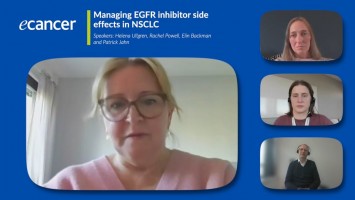
2: Managing EGFR inhibitor side effects in NSCLC - Skin toxicity impact, adherence challenges, and nursing management
8 Jun 2026

The content on this site is intended for healthcare professionals only
Helena Ullgren (Clinical Nurse Leader, Karolinska Institute, Sweden), Rachel Powell (Advanced Clinical Practitioner, Haematology & Oncology, University Hospitals Birmingham NHS Foundation Trust, UK), Irati Rodriguez-Matesanz (Oncology Nurse Practioner, City of Hope Cancer Centre, Atlanta, USA) and Elin Backman Stålnacke (Oncology Contact Nurse, Karolinska Institute, Sweden) discuss safe administration and dosing of EGFR inhibitors in NSCLC.
This expert panel discussion highlights the real-world challenges of managing patients on EGFR-targeted therapies, including amivantamab and tyrosine kinase inhibitors, with a focus on toxicity management, adherence, and treatment delivery.
The panellists emphasise that while many side effects such as skin toxicities, eye complications, gastrointestinal issues, and thromboembolic risk may not always be life-threatening, they can significantly impact quality of life and treatment compliance. Early and proactive management, particularly in the first weeks of therapy, is critical.
The discussion also explores the complexities of oral therapies, including strict dosing schedules and food requirements, which can make adherence challenging despite their convenience. In contrast, intravenous and subcutaneous treatments offer structured administration but come with their own logistical and safety considerations.
A key takeaway is the importance of patient education, continuous monitoring (including telehealth tools), and strong nurse–patient communication to ensure adherence and optimize outcomes. Experts also highlight that maintaining treatment continuity is crucial, as interruptions may negatively impact disease control.
Overall, the panel underscores that personalized treatment selection, proactive toxicity management, and multidisciplinary support are essential to maximizing the benefits of modern targeted therapies in lung cancer.
| Experience of subcutaneous administration of amivantamab | |
| Risk of infusion-related reactions and their management | |
| The advantages and disadvantages of different drug administration routes |
Safe Administration and Dosing of EGFR Inhibitors in NSCLC: Practical Guidance for Oncology Nurses Supporting Patients Through Targeted Therapy
Helena Ullgren - Clinical Nurse Leader, Karolinska Institute, Sweden
Rachel Powell - Advanced Clinical Practitioner, Haematology & Oncology, University Hospitals Birmingham NHS Foundation Trust, UK
Irati Rodriguez-Matesanz - Oncology Nurse Practitioner, City of Hope Cancer Center, Atlanta, USA
Elin Backman Stålnacke - Oncology Contact Nurse, Karolinska Institute, Sweden
HU: Hi and welcome to this expert panel discussion that will focus on improving the education of nurses that manage patients with EGFR inhibitors. We will focus on patients with non-small cell lung cancer tonight. This is the first out of three videos on this topic and the first one here we will focus on the safe administration and different types of routes and dosing from a nursing perspective. My name is Helena Ullgren, I’m a specialist nurse and I work as a clinical nurse leader in Karolinska Comprehensive Cancer Center. I have the pleasure of introducing an expert panel and the first one is Rachel Powell, she’s an Advanced Clinical Practitioner and she works in University Hospitals in Birmingham NHS Foundation Trust in the UK. Then we have Irati Rodriguez-Matesanz and she’s an Oncology Nurse Practitioner and she works currently in City of Hope Cancer Center in Atlanta, United States. Last but not least we have Elin Backman Stålnacke, she’s an Oncology Contact Nurse and she works in Karolinska Comprehensive Cancer Center in Sweden. So welcome.
So this session, like I said, will focus on administration and dosing of EGFR inhibitors in non-small cell lung cancer. We will go into some discussions and both challenges and opportunities in terms of different types of administration routes. This list is basically just to illustrate that we do have a few different types of routes. We have the oral treatments, which would be the tyrosine kinase inhibitors and a few examples of them; then we have the antibodies that we also use in non-small cell lung cancer and we also have recently heard that we have a subcutaneous administration route that will come and be approved very soon in Europe and it’s already approved in Europe we learned from a press release today. But if we would start with the panel, maybe a little bit of reflection on that a subcutaneous administration route is coming, what that would mean for you as a nurse.
IRM: I can say that I have had actually the pleasure of treating patients with both the IV administration of amivantamab as well as the subcutaneous version already in clinical trials. I think that it’s exciting, we have other immunotherapies mostly that are already given subcutaneously, they usually decrease the duration of the administration for the patients which is one of the things that they like most. Of course then for nurses, but in the case of amivantamab the cases of infusion-related reactions were very high when we were administering it IV so we needed to split that first day into two, so excited to see that grade 3 reactions with the subcutaneous administration have really decreased, they are mostly 1-2, very lower rates. So we are thinking that it is going to be easier for both nurses and patients.
HU: Thank you. Anyone else.
RP: I agree. I think from experience the patients often don’t want to be on our day unit but they have to be and actually for the most part when we’ve looked at transferring patients from IV preparations of other drugs it does tend to be something that patients are quite keen to have if they’re going to be here a little bit less and if there’s a smaller chance of them having a reaction. Then, yes, I think we tend to get quite an enthusiastic buy-in from our patients.
EBS: I agree, I think it’s going to make a huge difference for the patients and the nurses providing the treatment because it’s going to be short visits and hopefully they will be feeling better also.
HU: I’m being a bit of the devil’s advocate here – do you think it’s a danger that people start referring this out to maybe other clinics outside of hospitals for subcutaneous injections? Do you have any ideas on that, your thoughts on how this in the most safe way should be handled?
RP: Particularly in the NHS where there is a move to have patients offered treatment a little closer to their home, then I do think there are more chemo at home options that are available, particularly in the UK. So it might be that homecare nurses, chemotherapy trained nurses, will be going out to somebody’s house to administer the treatment. Also we have in our primary care practices some of our primary care services have an area that we can use for a morning a week where patients can go a little closer to their home to have treatment. There are a lot of different ways of administering SACT to patients now where we’re trying to offer it close to their home. So, for example, some of our hospital trusts have a chemotherapy bus that is located on local supermarket car parks where patients can have their treatment. We do tend to only allocate patients or allocate treatments where there is a lower risk of infusion-related reactions, so where we can see in the safety data for amivantamab where there is a lower risk of infusion-related reaction.
HU: So it’s a double gain from also having the subcue administration route that you could maybe, if it’s less toxic in terms of infusion-related reactions, you could give it more at home to the patients. But anyone else want to comment on that? Any take home messages if you come into this and you haven’t worked with those patients before?
IRM: I think it depends so much on the geo-practical aspects of each location as well as do you have access to a specialised nurse that can still see and assess the patient. Can we get it started in community settings in a safe manner? Because even if amivantamab can now be given subcutaneously, it’s safer, it’s easier, it still has quite a lot of significant toxicities that require that oncology follow-up, that expert nurse follow-up. So I think at least I would consider doing the ramp-up the first month, give it in an oncology specialised centre and then maybe down the line and in the future we can see where some patients can get subsequent infusions administered more locally. But I think that we need to be aware that we are still going to need that support system for the patient and that specialised nurses and also not just the bulk administration but the follow-up and monitoring.
HU: Thank you. Any other comments? Feel free also to mention the IV route but I think we already touched upon that – the risk of infusion-related reactions is quite high and happens quite often.
RP: That’s a very valid point, actually. I think that we know that EGFR-targeting agents, they do have their very own, very specific, set of toxicities for patients. Especially from a derm perspective, the skin and nails, they require so much help to maintain and manage those toxicities. I think that’s probably across the board with all, whether it’s IV or the oral treatments, we do have some of our patients who do seem to struggle a little bit more with the derm toxicities. I think having somebody who understands those derm toxicities and is able to continue with that ongoing monitoring. Even we know that these patients are more likely to have quite coarse, curly eyelashes with treatment, some of our treatments, as well so more likely to get eye infections and all of the trappings that go along with that. A lot of these patients are more likely to get GI disturbance as well. Especially for amivantamab we do need somebody who is there that’s able to help to manage them from an anti-coag perspective as well, because we know those patients are potentially more likely to get VTEs. So I do think it’s a really valid point to have that closer monitoring, especially in that first few weeks or months of patients going on to that treatment.
HU: I will keep that line of thinking until I will… we can maybe focus on the oral administration route a little bit extra. So this is just an example of schedules of different types of tyrosine kinase inhibitors and, as you can see, it should be taken some of them with or without but some of them quite specific – before, after. I was wondering if any one of you wants to maybe have something to comment on this, how this works for patients?
EBS: Yes, the oral drugs, usually you think that they are easier to take for the patients, which normally they are. But it can sometimes be challenging to make sure that you haven’t eaten, you can’t eat if you missed your window and it does have to be eight hours until the next dose. It can be tricky to fit it in to the patient’s everyday life. It must be taken every day, no slipping with the doses. So in that case the subcutaneous or intravenous can be easier in some ways because you go to your appointment, you see your nurse, you get to talk a bit and then you go home and you’re finished for a couple of weeks. So I think it’s important to support the patient to fit this into their everyday life – do you take it the second you wake up, do you wait, what is the best route?
HU: I want to continue then to ask you, because we touched upon the skin toxicity we have that the patients actually… My experience tells me we sometimes miss out on how much that bothers our patients. Like it’s not life-threatening most times but it can bother someone quite a lot, even if it’s a grade 2 and not more. So I was thinking, I know that where you work, Elin, you have some way of monitoring patients remotely without having them to come in. Maybe you can mention that, instead of talking on the phone.
EBS: Yes, we try to see our patients, either that they send us pictures through an app that we have or if we can schedule online calls just to see them visually. Because someone can have quite severe rash and feel like it’s manageable and the other way round – it can be really impacting their quality of life but it’s maybe grade 1 or 2, as Helena mentioned. But it’s important to see the patient so you can help them get the right treatment for the skin toxicities.
HU: What do you think about the adherence then and relationships to toxicity? Anyone that wants to say something about that.
IRM: I was going to say that one of the strategies, for example, that I have utilised with TKIs specifically is, of course, if you know the patient, you see their baseline functional performance status, sometimes you cannot know exactly how the tolerability is going to go. But I tend to err on the side of if they are frail, if they have multiple comorbidities, we can initiate them at the dose level -1. So, for example, with osimertinib let’s go to 40mg instead of 80mg a day, make the dose toxicities more manageable at first, and then ramp that up if we can. One thing that I would say is also luckily osimertinib, lazertinib, more like these third generation TKIs, can be given one per day with or without food. I feel like they are easier to take which makes it easier on the patient but then it is also our job as nurses to say, ‘Hey what is your routine?’ How can we help the patient, say, morning is going to work better for you or night, set up an alarm on the phone, have a Post-It on the fridge to remind yourself to take it and to take it correctly. Then, yes, if we can use telehealth remote monitoring to support these patients, we need to use all the tools that we have and adapt to new work types of therapies.
RP: Yes, I do agree. I think that there is a lot to be said for that good quality patient assessment when choosing one of these agents. Also the counselling ahead of them starting the treatment. I do tend to find that any patients starting on any EGFR treatment, if they have that good quality counselling initially when we’re talking to them about using an SPF for those particularly sunnier days, when we’re talking about moisturisation, when we’re talking to them about keeping their fingernails and toenails nice and clean. Because we know that those patients, we know that they might have a bit of a difficult time on EGFR treatments. I do think we shouldn’t downplay it, you’re right Helena, I think that we have a responsibility to help those patients with compliance. They’re not going to be compliant if they’re struggling a lot with their skin or they’re struggling to get their shoes on, just to get out and about, because their toenails hurt so much or they’re very infected. They’re not going to be so keen to get out and about if actually they are covered in rash and they don’t feel like they look like the person that they were before they started. So that compliance is really important and I think how we can help those patients is that really good quality counselling initially but then that follow-up with them as well and ensuring that we are doing a good quality assessment of the patient throughout their treatment. I think that’s how we help them stay compliant.
HU: I agree. Anything else from you, Elin, on this topic before we move on?
EBS: No, I also think it’s very important to do the initial education and counselling throughout and make sure that they get the prescribed skin softener and so on. And talk to the patient that there can be side effects, it doesn’t necessarily mean that we need to stop your treatment, there’s a lot we can do and it’s important that you let us know how you’re feeling and if there’s anything. Also that you build a trust so that the patient can know they can call me and they know they can tell me and I can give them advice and make sure before we do dose reduction that we have done everything else we can do.
HU: Thank you. I think in terms of the next we are not going to dive into the intravenous administration, we already spoke about the challenges. I only want to mention that it can be more challenging, like you said before, Irati, you mentioned if they have a reaction it can be quite tricky, you have to give it and you have to stop it and start again and things like that. So I think that just also my message here would be that we need to have protocols for this, proper, that’s really important in terms of even though how well-educated we are, we need to have a protocol for the administration IV.
But I think other than that I want to move on to the summary because I think we very well talked about the different routes of administration and how the oral, the IV, the subcutaneous, there are both advantages and disadvantages. But really key to have educated cancer nurses. I was thinking about that in terms of just the side effects, that if you have someone that knows then the person can also comfort you and say that sometimes this actually gets better, and it goes up and down a little bit. Because you have your rash now, for example, it doesn’t mean that you’re going to have it forever during the treatment. So I do find that education-wise we cannot underestimate the side effects of oral drugs as well, that’s something I was thinking of. But is there anything else in terms of safety or any reflection with focus on the different administration routes that you want to summarise with here?
RP: Just a little while ago I did a little project on ctDNA with patients who had EGFR-sensitising mutations. So we were tracking patients’ ctDNA of their sensitising mutation in their blood while they were on treatment and actually any changes in that. There were a couple of patients who actually stopped their treatment due to skin toxicity and we actually tracked their ctDNA during that time and we could see that the amount of sensitising mutation in their blood seemed to increase during that treatment break. So I do think it says a lot for the importance. We had patients that had oligometastases and you could see their sensitising mutation crept up and when they had radiotherapy to their oligometastases, actually their sensitising mutation came down after that as well. It was a very interesting little project but I think it does go to show the importance of actually that compliance for patients who are taking the medication.
IRM: Yes, I think that’s a very important thing that you are bringing up. Also when we are talking about safety, tolerability of these therapies, I would bring up that it’s great that now we have different routes of administration for patients with non-small cell lung cancer with EGFR mutation, even different options approved in the first-line setting. Do we want to go with something that is oral like osimertinib, do we want to go with amivantamab subcutaneously? So I think it’s also trying to choose the right medication at the right time for the right patient.
That is a big one but then also remember that a lot of these therapies are not given as single agent, right? Like now osimertinib, we prefer if we give it in combination with chemotherapy, so with pemetrexed. So the way in which we dose these medications, the way in which we monitor these patients, it’s going to be still complicated, it’s not just a pill that they take at home and they forget about it. They still bring challenges and we need to be up to date because a lot of these are… lazertinib in combination with amivantamab – we are giving multiple therapies at the same time, different routes. So also for the patients to remember everything that they need to be doing, it can become quite challenging. So having expert nurses and that support can make a huge difference in adherence to any type of therapy.
HU: Yes. Thank you, and I think that really summarised the discussion we had. I think we’re going to dive more into the toxicity and side effects in one of the other sessions, which will be great, because they all belong together but we talked through how this can be impacted and the disadvantages of the different administration routes. Thank you so much for doing this panel today and for your insights. Thank you.
2: Managing EGFR inhibitor side effects in NSCLC - Skin toxicity impact, adherence challenges, and nursing management
Low-dose pembrolizumab plus chemotherapy improves survival and expands access in advanced NSCLC
Rilvegostomig clears ctDNA and delays recurrence in high-risk head and neck cancer

WCLC 2025: Latest in EGFR positive NSCLC

Key insights from lung cancer research at ASCO 2025

Dermatologic adverse events in the treatment of NSCLC with amivantamab plus lazertinib significantly reduced

Isatuximab survival benefit over VRd in transplant-ineligible newly diagnosed multiple myeloma
