Early-onset gastrointestinal cancers show more advanced disease and wider racial survival gaps
1 Jun 2026

The content on this site is intended for healthcare professionals only
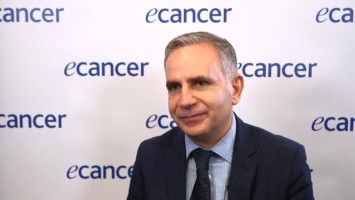
Dr Filippo Pietrantonio speaks to ecancer about an analysis from the CodeBreaK 300 trial investigating circulating tumour DNA (ctDNA) as an early biomarker of treatment response in KRAS G12C-mutant metastatic colorectal cancer.
He reports that early ctDNA clearance was observed more frequently in patients receiving sotorasib plus panitumumab than in those receiving standard therapy, and was strongly associated with radiographic tumour shrinkage.
Dr Pietrantonios explains that these findings support early ctDNA clearance as a promising non-invasive biomarker for predicting treatment response and outcomes in patients receiving KRAS G12C-targeted therapy.
The CodeBreaK 300 phase III study was a trial investigating in late-line setting in patients with KRAS G12C mutated metastatic colorectal cancer the PFS superiority of sotorasib 960mg plus panitumumab combination versus investigator’s choice chemotherapy of trifluridine tipiracil or regorafenib. This is a practice-changing study for patients with a molecularly selected subgroup of patients representing about 3% of patients with metastatic colorectal cancer.
In this exploratory subgroup analysis we analysed paired plasma signposts obtained at baseline and at cycle 2 day 1, meaning approximately four weeks after treatment start and before radiological reassessment. ctDNA clearance was evaluated with KRAS G12C variant allele frequency and also with methylation-based circulating tumour fraction.
So in this study we saw that early ctDNA clearance was markedly superior with the two sotorasib and panitumumab arms in the trial, sotorasib at the standard dose or lower dose of 240mg, both associated with panitumumab, versus the control arm. Also complete ctDNA clearance was highly reached in the two experimental arms with sotorasib and panitumumab.
Another important point is that the KRAS G12C allele frequency was strongly associated with radiographic tumour shrinkage and also investigated the prognostic impact of early ctDNA clearance and liquid biopsy in terms of progression free and overall survival. Across all study arms the early ctDNA clearance was associated with longer progression free and overall survival and, in particular, progression free survival and overall survival in the standard dose of sotorasib 960mg plus panitumumab were approximately 6 months progression free survival and not reached at a median follow-up of more than 14 months in patients with ctDNA clearance. These patients were the majority of patients in this treatment arm.
So, basically, this is a study showing that early ctDNA clearance can be used as an early biomarker of treatment efficacy and, of course, prognosis in patients with KRAS G12C mutated metastatic colorectal cancer treated with the targeted therapy. But, of course, liquid biopsy can be used in different settings in patients with metastatic colorectal cancer and even in early-stage disease. So this is a useful tool and we need additional validation to establish the clinical value and the cost effectiveness for the use of liquid biopsy in clinical practice.
What impact could these findings have?
Still the use of liquid biopsy is patchy across the world because there is approval and reimbursement in some countries. For example, in the US liquid biopsy is prescribed to really guide the treatment decision and to help in monitoring the disease course and the treatment response. But in other countries to get reimbursement we need also to demonstrate the cost effectiveness and the clinical value. To do this we need really biomarker-driven trials.
Another important application for the clinical practice is the monitoring because in this study we investigated early ctDNA clearance but samples obtained at the time of disease progression may really show the mechanisms of acquired resistance to several targeted therapies, including sotorasib and panitumumab, or KRAS G12C inhibition strategies in general. So this is really important if we want to really adapt the treatment over the course of the disease and really offer additional options of therapy through the course of the disease to our patients. This is just the beginning, we need additional data, but liquid biopsy will have future clinical applications more and more over the course of time.
Early-onset gastrointestinal cancers show more advanced disease and wider racial survival gaps
Tarlatamab improves brain metastases control and survival compared to chemo in SCLC
Trastuzumab and tucatinib enable organ preservation in HER2-positive rectal cancer

Zolbetuximab plus nivolumab and chemotherapy shows promising responses in CLDN18.2-positive metastatic gastric cancer

Physical activity reduces fatigue and improves quality of life in colorectal cancer survivors

Zanidatamab improves PFS and OS in first-line HER2-positive metastatic gastric cancer

Consolidation treatment delays do not compromise survival in MRD-negative adult ALL
Addition of trastuzumab to chemo does not provide significant survival benefit in HER-2 positive stomach cancer

Nivolumab plus ipilimumab shows superior efficacy in metastatic colorectal compared to nivolumab monotherapy
