Zolbetuximab plus nivolumab and chemotherapy shows promising responses in CLDN18.2-positive metastatic gastric cancer

23 Mar 2026

The content on this site is intended for healthcare professionals only
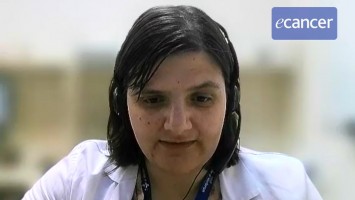
Dr Elena Élez speaks to ecancer about results from a phase I/II trial testing invikafusp alfa, a first-in-class bispecific antibody that targets the TCR-beta chain. The study looks at its use as monotherapy in patients with antigen-rich gastrointestinal (GI) cancers who had already developed resistance to anti-PD(L)1 therapy.
The findings are encouraging: invikafusp showed meaningful anti-tumour activity across several GI cancers, with particularly strong signals in colorectal cancer. The trial reported an overall response rate of 23–25% and a disease control rate of 63%.
Looking ahead, researchers plan to refine patient selection and expand the trial to include individuals with specific molecular profiles, with the goal of better identifying who may benefit most from this treatment
This is quite a new clinical trial, this is with a new compound called invikafusp. Invikafusp is a bispecific monoclonal antibody that tried to reinvigorate anti-tumour T-cell responses. The clinical trial is very interesting because although it is a early phase, several patients with solid tumours, including patients with GI malignancies, were included in the clinical trial. The trial demonstrated benefit in terms of overall response rate for these patients that, as mentioned, included not only colorectal cancer but also other GI tumours, specifically patients as well with an MSI high status. It described a response rate of between 23-25% and a disease control rate of 63% which is huge for a clinical trial in a heavily pretreated population with this particular compound.
What is the significance of these results and what is next for this study?
What we have seen with this clinical trial is that the compound has activity in this heavily pretreated population so probably the next step is to better study this particular compound in some patients, like is the case of patients with colorectal cancer, maybe with a better selection, for example, those patients with a high mutational burden and maybe low tumour burden. Because we have seen that for those patients that are carrying a tumour without MSI conditions, being MSS but without liver mets or what it could be low tumour burden, could have the chance to respond to this particular compound.
So the next step is to see the results of the expansion cohort with more patients with GI tumours and colorectal cancer illness and see the efficacy in patients with this particular molecular profile and clinical profile.
Zolbetuximab plus nivolumab and chemotherapy shows promising responses in CLDN18.2-positive metastatic gastric cancer
FFX/bevacizumab plus atezolizumab improves PFS in first-line dMMR/MSI-H mCRC

Toripalimab plus chemotherapy improves 3-year survival in resectable gastric/GEJ cancer

Physical activity reduces fatigue and improves quality of life in colorectal cancer survivors

Zanidatamab improves PFS and OS in first-line HER2-positive metastatic gastric cancer

Zanzalintinib plus atezolizumab improves survival in refractory mCRC
Domvanalimab, zimberelimab and FOLFOX shows durable survival in advanced HER2-negative GC/GEJC/EAC
WCLC 2025: Latest in EGFR positive NSCLC

Dose escalation of RG6344 demonstrates safety and promising activity in BRAF V600E solid tumours