
Supporting oncology professionals through education
The content on this site is intended for healthcare professionals only
The content on this site is intended for healthcare professionals only
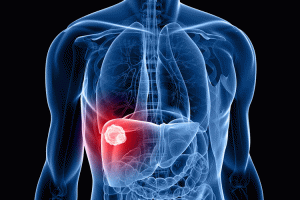
Immunotherapy – which activates the body’s own immune system to kill cancer cells – has not worked well against a rare and fatal liver cancer, but a new Cornell University study finds an existing FDA-approved drug may allow the immunotherapy to fight the cancer as intended, opening the door to a potential treatment.
Fibrolamellar carcinoma primarily affects children and young adults and accounts for up to 2% of all liver cancers.
It currently has no cure and has often metastasised by the time it is detected, leaving patients with a short life expectancy.
The study, published Feb. 17 in the journal Gastroenterology, describes how fibrolamellar tumours rewire their local microenvironments such that the body’s immune T cells become sequestered away from the cancer cells where they can’t fight the disease – a process called T-cell exclusion.
They also found that AMD3100, a drug currently used to treat a different disorder, can prevent the tumours from sequestering T cells, freeing them to attack the cancer.
“Our results provide among the first indications of why a type of immunotherapy called immune checkpoint inhibition hasn’t worked well in these patients, and even if this particular drug isn’t the end-all-be-all, it teaches us that this T-cell exclusion phenomenon is an important one to tackle in fibrolamellar carcinoma,” said Praveen Sethupathy, professor of physiological genomics and the paper’s co-senior author.
Normally, when clinicians administer immune checkpoint inhibitors, they activate the body’s own immune T cells to migrate to the core of the cancer to try and kill the tumour cells.
Immune checkpoint inhibitors can be highly effective against liver, lung, kidney and bladder cancers, as well as melanoma, but many cancers – pancreatic, prostate, brain – can be resistant.
The tumour microenvironment and T-cell sequestration provide clues to why some cancers don’t respond to immune checkpoint inhibitors.
Researchers used patient tumour slices to test AMD3100 and found that it effectively mobilised T cells into the core of the tumour.
Moreover, combining AMD3100 together with immune checkpoint inhibition further facilitated activation of T cells, leading to a significant increase in the death of tumour cells.
Sethupathy and colleagues are currently searching for liver cancer clinicians who might be interested in starting clinical trials for the new treatment.
“A compelling feature of this work is that AMD3100 is already FDA-approved, which can reduce risks and potentially speed up timelines for clinical trials in fibrolamellar carcinoma,” Sethupathy said.
Source: Cornell University
The World Cancer Declaration recognises that to make major reductions in premature deaths, innovative education and training opportunities for healthcare workers in all disciplines of cancer control need to improve significantly.
ecancer plays a critical part in improving access to education for medical professionals.
Every day we help doctors, nurses, patients and their advocates to further their knowledge and improve the quality of care. Please make a donation to support our ongoing work.
Thank you for your support.