Introduction: Infusional 5-fluorouracil (5-FU) or capecitabine are commonly used in the management of gastrointestinal tract. So far very few studies have evaluated non dermatological, neurological and intestinal treatment related toxicities between these two fluoropyrimidine in African patients – evaluating the healthcare burden related to hospitalisations, blood transfusions and use of granulocyte colon-stimulating factor (G-CSF) – all of which are costly and scarce in Africa.
Methods: We conducted a 10-year retrospective cohort study of black African patients with gastrointestinal cancer who received either 5-FU or capecitabine-based chemotherapy – extracted and analysed data on treatment related adverse events (TRAEs) incidence, severity and management.
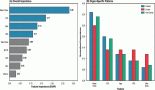
Results: A total of 179 participants were analysed: 100 received 5-FU and 79 received capecitabine. The incidence of any TRAE was 75/100 (75%) in the 5-FU group and 51/79 (65%) in the capecitabine group relative risk (RR 0.86, 95% confidence interval (CI) 0.7–1.05; p = 0.15). Severe TRAEs occurred at similar rates: 33% for both groups (RR 0.99, 95% CI 0.7–1.52; p = 0.95). Haematological TRAEs were comparable except for neutropenia, which was less common with capecitabine (33% versus 52%, RR 0.63, 95% CI 0.43–0.91; p = 0.01). Severe anaemia occurred more frequently in the capecitabine group compared to the 5-FU group, with a RR of 2.6 (95% CI 1.02–6.55). Hypokalemia was also lower with capecitabine (6% versus 17%, RR 0.37, 95% CI 0.14–0.97; p = 0.04). Hospitalisation, G-CSF use and red blood cell transfusions were similar between groups, but treatment interruptions were less frequent with capecitabine (16% versus 50%, RR 0.33, 95% CI 0.19–0.56; p < 0.0001). Treatment completion rates were 60% for 5-FU and 54% for capecitabine (p = 0.10).
Conclusion: Both infusional 5-FU and capecitabine are generally well tolerated among African patients with gastrointestinal cancer. However, capecitabine is associated with a significantly lower risk of neutropenia and hypokalemia but a higher RR of severe anaemia with overall fewer incidents of treatment interruption.