Workforce proficiency, diagnostic roles and access to advanced haematology diagnostics in Lagos, Nigeria
Olufemi Abiola Oyedeji1a, Ayoola Moses Bakare2, Nosimot Omolola Davies1, Olusola Festus Olowoselu1 and Ann Abiola Ogbenna1
1Department of Haematology and Blood Transfusion, College of Medicine, University of Lagos, Lagos 101014, Nigeria
2Lagos State Primary Healthcare Board, Lagos 101212, Nigeria
a https://orcid.org/0000-0001-7101-5240
Abstract
Background: Accurate diagnosis of haematological malignancies (HMs) requires a skilled multidisciplinary workforce and access to advanced diagnostic techniques, yet both remain constrained in many low- and middle-income countries. This study assessed diagnostic proficiency, role distribution and access to advanced haematology diagnostics among medical laboratory scientists and haematologists in Lagos State, Nigeria.
Methods: A descriptive cross-sectional study was conducted across 11 public hospitals in Lagos State between May and October 2025. Eligible participants were 54 medical laboratory scientists and 21 haematologists, recruited via a census of consenting staff. Data were collected using structured, self-administered questionnaires developed for this study, covering demographics, self-reported diagnostic proficiency, clinical exposure, access to advanced tools and training experiences.
Results: Self-reported proficiency in complete blood count interpretation was high overall but significantly higher among haematologists than medical laboratory scientists. Advanced diagnostic proficiency was limited across both groups, with only 2.7% reporting expert proficiency in flow cytometry, none in cytogenetics and 5.3% in molecular diagnostics. Haematologists reported diagnosing all leukaemia cases in their practice and most lymphoma, multiple myeloma and myelodysplastic syndrome cases, whereas participation by medical laboratory scientists in these diagnoses was much lower. Only one teaching tertiary hospital reported access to flow cytometry, and no participating facility reported access to cytogenetics, polymerase chain reaction, fluorescence in situ hybridisation or next-generation sequencing. Most haematologists rarely requested advanced diagnostic investigations. Regular training was reported in 27.3% of institutions, while trainer shortages and lack of funding were the main barriers.
Conclusion: The haematology diagnostic workforce in Lagos demonstrates adequate proficiency in basic procedures but critical deficits in advanced diagnostics required for contemporary classification of HMs. These findings reflect a broader pattern seen across low- and middle-income settings, where limited access to advanced diagnostics, workforce shortages and weak laboratory systems constrain accurate disease classification and equitable care. Strengthening training, task-sharing and international partnerships is urgently needed to improve diagnostic capacity.
Keywords: haematological malignancies, laboratory workforce, proficiency, Nigeria, diagnostic capacity, task sharing, continuing professional development
Correspondence to: Olufemi Abiola Oyedeji
Email: ooyedeji@unilag.edu.ng
Published: 15/10/2026
Received: 23/04/2026
Publication costs for this article were supported by ecancer (UK Charity number 1176307).
Copyright: © the authors; licensee ecancermedicalscience. This is an Open Access article distributed under the terms of the Creative Commons Attribution License (http://creativecommons.org/licenses/by/4.0), which permits unrestricted use, distribution, and reproduction in any medium, provided the original work is properly cited.
Introduction
Accurate and timely diagnosis of haematological malignancies (HMs) depends on both diagnostic infrastructure and the competence of the workforce using it. Medical laboratory scientists and haematologists must be competent across a spectrum of diagnostic procedures, as contemporary classification systems increasingly rely on immunophenotypic, cytogenetic and molecular data [1–3].
Both the World Health Organization and the International Organization for Standardization (ISO 15189) emphasise that laboratory personnel must demonstrate appropriate education, training and competency for each diagnostic modality they perform [4, 5]. These requirements are difficult to meet in many low- and middle-income countries (LMICs), where access to high-quality pathology, advanced diagnostics and trained personnel remains inconsistent [6, 7]. There is a well-documented shortage of laboratory professionals, particularly in LMICs. Sub-Saharan Africa bears approximately 24% of the global disease burden but has only 3% of the global health workforce [8]. In laboratory medicine, this gap is especially pronounced, with many African countries having less than one pathologist per million population, compared with more than 50 per million in high-income settings [9]. In Nigeria, recent studies have documented critical shortages of pathologists, haematologists and medical laboratory scientists, alongside marked disparities in their distribution across urban and rural settings and between tertiary and secondary healthcare facilities [10–12].
For the diagnosis of HMs, international guidance recommends a minimum workforce comprising two to three specialist haematologists and four to six medical laboratory scientists per diagnostic service unit serving populations exceeding 500,000 [13]. By this standard, Lagos State, with an estimated population of 17.8 million [14], would require approximately 70–100 haematologists and 140–200 specialised medical laboratory scientists to achieve adequate diagnostic coverage. These figures substantially exceed the current capacity.
Beyond workforce numbers, proficiency in specific diagnostic techniques is critical. In some settings, reliance on morphology alone has led to substantial diagnostic discordance, including less than 40% concordance for suspected lymphoma when local morphology-based diagnoses were compared with integrated expert review that involves additional ancillary testing [6]. Advanced modalities such as flow cytometry for immunophenotyping, cytogenetics for detecting chromosomal abnormalities and molecular diagnostics (including polymerase chain reaction (PCR) and next-generation sequencing) for identifying clinically relevant mutations are central to contemporary, WHO-aligned classification, risk stratification and treatment selection in HMs [15, 16]. However, in many LMICs, training programmes provide limited exposure to these technologies, and practising professionals often lack opportunities for structured skill advancement [17, 18].
Optimal HM diagnosis requires a multidisciplinary, team-based approach in which responsibilities are distributed according to competence. In resource-limited settings, however, this balance is frequently disrupted. Haematologists may become overburdened with tasks that could be appropriately delegated, while medical laboratory scientists may either be underutilised or, conversely, perform diagnostic interpretations beyond their formal training [6, 15]. Evidence-based task sharing, where defined diagnostic responsibilities are assigned to appropriately trained personnel, has been shown to improve efficiency and expand access to care without compromising diagnostic quality [4].
Continuous training and continuing professional development (CPD) are essential to maintaining and improving workforce competence, but in many LMIC contexts, they remain underfunded, irregular or inaccessible. In Nigeria, few studies have reported that participation in CPD programmes by medical laboratory scientists is constrained by financial barriers, limited institutional support and a scarcity of relevant training opportunities, despite recognition of their importance by this professional group [20, 21]. International collaborations and twinning partnerships have demonstrated effectiveness in strengthening laboratory capacity and workforce skills, yet such initiatives remain limited in scope and reach [22, 23].
Despite these challenges, empirical data on workforce proficiency, diagnostic role distribution and access to advanced diagnostics for HMs in Nigeria remain limited. This study, therefore, aimed to assess self-reported proficiency in haematological diagnostic procedures across professional groups; examine role distribution in the diagnosis of specific HM subtypes; evaluate access to and utilisation of advanced diagnostic techniques and identify training practices, barriers and opportunities for workforce development.
Materials and methods
Study design and setting
A descriptive cross-sectional study was conducted between May and October 2025 across 11 public hospitals in Lagos State, Nigeria. The study sites comprised eight secondary hospitals, two teaching tertiary hospitals and one non-teaching tertiary hospital, all of which had functional haematology departments and at least one practising haematologist.
The study focused on workforce characteristics, diagnostic proficiency and practices related to the diagnosis of HMs.
Participants
Eligible participants included:
(i) haematologists (pathologists) actively involved in the diagnosis of HMs and employed at the study institutions for at least 6 months; (ii) medical laboratory scientists with a bachelor’s degree, working in haematology laboratories and involved in diagnostic processes for at least 6 months and (iii) heads of haematology laboratory departments for institutional-level data.
Resident doctors and laboratory interns were excluded to ensure assessment of fully qualified practitioners. Hospitals without a resident haematologist and military hospitals were also excluded.
All eligible individuals who provided informed consent were recruited using a census sampling approach, yielding a final sample of 75 participants (54 medical laboratory scientists and 21 haematologists). As only the final sample is reported, information on the number approached, those who declined participation and the characteristics of non-responders was unavailable, limiting assessment of potential participation bias.
Data collection
Data were collected using structured, self-administered questionnaires developed specifically for this study and administered in paper-based and electronic formats (Appendix 1).
The instrument comprised five sections covering demographic and employment characteristics, self-reported diagnostic proficiency, clinical exposure to specific HMs, access to diagnostic tools and training experiences. Diagnostic proficiency was self-rated on a three-point scale of no experience, basic proficiency and expert across complete blood count (CBC) interpretation, bone marrow aspiration and biopsy, flow cytometry, cytogenetics and molecular diagnostics including PCR and next-generation sequencing. All responses were anonymised and coded before analysis. Although the questionnaire was domain-specific, there was little or no pilot testing, formal psychometric validation or reliability assessment.
Data analysis
Data were entered into Microsoft Excel for cleaning and subsequently analysed using IBM SPSS Statistics for Windows, Version 27.0.1 (IBM Corp., Armonk, NY, USA). Descriptive statistics were used to summarise the data, and categorical variables were presented as frequencies and percentages. Associations between professional group and nominal categorical variables with sparse contingency tables were assessed using the Fisher–Freeman–Halton exact test, which is appropriate for contingency tables larger than 2 × 2 when expected cell frequencies are small; effect sizes were quantified using Cramer’s V. Because self-reported proficiency was measured on an ordinal three-level scale, comparisons between medical laboratory scientists and haematologists were performed using the Mann–Whitney U test. Statistical significance was defined as p < 0.05.
Ethical considerations
Ethical approval was obtained from the Health Research Ethics Committees of the Lagos University Teaching Hospital (ADM/DSCST/HREC/APP/7082), Lagos State University Teaching Hospital (LREC/06/10/2858), and Federal Medical Centre, Lagos (HREC 25-06). Additional approval was obtained from the Lagos State Health Service Commission (LSHSC/2222/VOLV/XX). Written informed consent was obtained from all participants before data collection.
Results
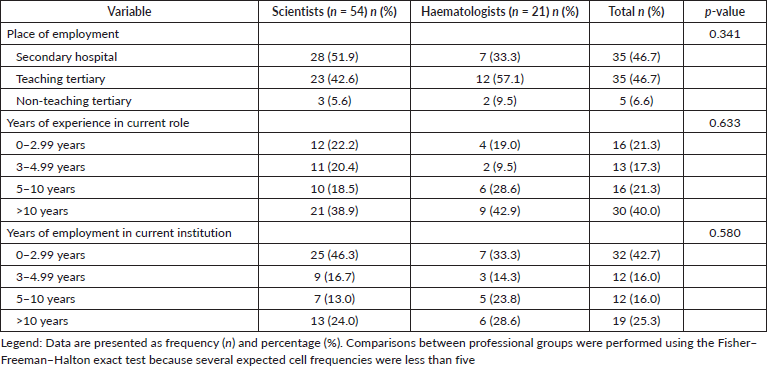
A total of 75 participants were included in the study, comprising 54 (72%) medical laboratory scientists and 21 (28%) haematologists across 11 institutions. Most respondents were employed in secondary and teaching tertiary hospitals (35 (46.7%) each), and the distribution of hospital type did not differ significantly between professional groups. Similarly, years of experience in the current role were broadly comparable between the two groups.
There was no significant difference between medical laboratory scientists and haematologists in place of employment, with the Fisher–Freeman–Halton exact test showing no association between professional group and hospital type distribution (p = 0.341). The same was true for years of experience in the current role, which also did not differ significantly between groups (p = 0.633). Table 1 therefore suggests that the two professional groups were reasonably comparable in their employment setting and role experience (Table 1).
Table 1. Demographic and employment characteristics by profession (n = 75).
Self-reported proficiency differed significantly between professional groups for CBC interpretation and bone marrow aspiration/biopsy. Haematologists reported higher proficiency than medical laboratory scientists for both procedures, with Mann–Whitney U values of 312.0 for CBC and 144.0 for bone marrow aspiration/biopsy, both with p = 0.001. In contrast, proficiency in flow cytometry did not differ significantly between groups (U = 512.5, p = 0.462), and molecular diagnostics also showed no significant difference (U = 507.5, p = 0.424). Cytogenetics showed a statistically significant difference, with haematologists reporting higher proficiency than medical laboratory scientists (U = 433.5, p = 0.049), although overall proficiency remained limited.
Overall, basic diagnostic skills were stronger than advanced diagnostic skills in both groups. Expert-level proficiency was common for CBC interpretation and much more frequent among haematologists for bone marrow aspiration/biopsy, but expert-level capability was rare for flow cytometry and molecular diagnostics and absent for cytogenetics (Table 2).
Table 2. Self-reported proficiency in haematological diagnostic procedures.

Leukaemia was the most frequently diagnosed haematological malignancy overall (63 (84.0%)). All haematologists reported diagnosing leukaemia (21 (100%)), compared with 42 (77.8%) laboratory scientists (χ² = 4.03, p = 0.045).
Marked differences were also observed for other malignancies. Lymphomas were diagnosed by 14 (66.7%) haematologists compared with 7 (13.0%) laboratory scientists (χ² = 19.05, p < 0.001). Similarly, multiple myeloma was diagnosed by 19 (90.5%) haematologists versus 5 (9.3%) laboratory scientists (χ² = 42.18, p < 0.001). Myelodysplastic syndromes (MDS) were diagnosed by 13 (61.9%) haematologists but only by 4 (7.4%) laboratory scientists (χ² = 22.60, p < 0.001) (Table 3).
Advanced diagnostic tests were largely unavailable across the participating institutions. Only one teaching tertiary hospital reported access to flow cytometry, and no participating facility reported availability of cytogenetics, PCR, fluorescence in situ hybridisation (FISH) or next-generation sequencing. Among haematologists, 16 (76.2%) reported rarely requesting advanced diagnostic investigations, 3 (14.3%) occasionally and none frequently (Table 4). A small proportion (2 (9.5%)) indicated that such services were entirely unavailable in their facility.
Diagnostic oversight of laboratory processes was reported by 20 (95.2%) haematologists. Among institutions utilising referral laboratories, most relied on private facilities (7 (58.3%)), followed by public laboratories (3 (25.0%)) and a combination of both (2 (16.7%)).
Training opportunities varied across institutions. Regular training was reported in 3 (27.3%) institutions, occasional training in 5 (45.5%) and rare training in 3 (27.3%). Access to CPD or external training was available in 8 (72.7%) institutions (Table 5).
Table 3. Frequency of HMs diagnosed by profession.

Table 4. Frequency of use of advanced diagnostic tests among haematologists (n = 21).

Table 5. Training practices and barriers across institutions (n = 11 hospitals).

Major barriers to training included a shortage of qualified trainers (9 (81.8%)), lack of funding (8 (72.7%)) and limited availability of training programmes (4 (36.4%)) (Table 5). International collaborations or twinning partnerships for workforce development or enhancement of diagnostic capacity were absent in all study sites.
Discussion
This study provides a systematic assessment of haematology workforce proficiency, role distribution and access to advanced diagnostics for the diagnosis of HMs in Lagos State, Nigeria. The findings reveal substantial constraints in diagnostic capacity, with clear gaps in advanced proficiency, a strong concentration of diagnostic responsibility among haematologists and limited access to modern diagnostic tools. These deficits are further compounded by irregular training, funding constraints and the absence of international collaboration, collectively limiting workforce development and diagnostic capacity. This pattern aligns with broader evidence from LMICs, where haematolymphoid malignancy diagnosis is limited by inconsistent pathology quality, restricted access to advanced testing and workforce shortages [6, 24].
While proficiency in basic haematology, particularly CBC interpretation, appears adequate, likely reflecting foundational undergraduate and early postgraduate training, competence in advanced diagnostics is critically limited. The near absence of expert-level proficiency in flow cytometry, cytogenetics and molecular diagnostics represents a major barrier to WHO-aligned diagnosis of HMs. Contemporary classification frameworks, including the WHO classification (2018) and the International Consensus Classification (2022), require immunophenotyping and genetic testing for accurate lineage assignment, risk stratification and treatment selection [3–5]. In the absence of these competencies, precision diagnosis and personalised therapy remain unattainable.
These findings are consistent with evidence from other low- and middle-income settings. In Tanzania, Makani et al [25] reported limited exposure to flow cytometry and molecular techniques within haematology training programmes, necessitating reliance on external laboratories. Similarly, in Nigeria, Okoye et al [19] found that only a small proportion of haematological malignancy cases underwent cytogenetic testing due to an absence of local capacity. The present study extends these observations by demonstrating that the gap is not only infrastructural but also reflects limited individual and workforce-level proficiency.
The lack of cytogenetics expertise is particularly concerning, given the critical role of chromosomal analysis in the diagnosis, prognostication, and treatment selection of acute and chronic leukaemias [26]. In such contexts, clinicians are forced to rely predominantly on morphology, increasing the risk of diagnostic misclassification and suboptimal treatment [7, 27].
The potential for diagnostic misclassification warrants more explicit acknowledgement. Evidence from Guatemala shows that morphology‑based lymphoma diagnoses achieved less than 40% concordance with integrated approaches incorporating ancillary testing [6]. Similarly, Nigerian review data highlight frequent missed or incorrect diagnoses when morphology is used without immunohistochemistry, immunophenotyping or PCR [28]. Emerging low‑cost molecular strategies may help narrow this gap; for example, a paraffin‑based gene‑expression assay demonstrated 86% validation accuracy, rising to 94% after excluding indeterminate calls in lymphoma classification [29].
The marked disparity in the diagnosis of lymphomas, multiple myeloma and MDS, where haematologists account for most diagnoses while medical laboratory scientists contribute minimally, suggests a breakdown of the multidisciplinary diagnostic model. International best practice supports a collaborative approach in which medical laboratory scientists, under appropriate supervision, perform initial assessments, with haematologists responsible for integrated diagnosis and complex case interpretation [9, 13]. The observed imbalance likely reflects a combination of limited training exposure, restrictive institutional policies and the absence of clearly defined task-sharing frameworks.
This imbalance has important implications. Over-reliance on haematologists for diagnostic tasks may contribute to workforce inefficiency and clinician burnout, while simultaneously underutilising the skills of laboratory scientists. Evidence from South Africa demonstrates that, following structured competency-based training, medical laboratory scientists can perform bone marrow differentials with high concordance with haematologists (κ > 0.85), supporting the feasibility of task sharing in similar settings [30].
The limited use of advanced diagnostic investigations, reported as rarely requested by 76.2% of haematologists, appears to reflect both restricted availability and clinician adaptation to resource constraints. A tendency to avoid requesting tests perceived as unavailable may contribute to continued underutilisation even if capacity expands. Dependence on private reference laboratories further underscores gaps in public diagnostic infrastructure and raises concerns about equitable access, given the frequent need for out‑of‑pocket payment.
Restricted access to advanced diagnostics may have important clinical implications. For example, without flow cytometry, distinguishing between acute myeloid leukaemia and acute lymphoblastic leukaemia can be uncertain, potentially affecting treatment choices. Similarly, the absence of cytogenetic and molecular testing limits risk stratification and the use of targeted therapies such as FLT3 or IDH inhibitors [16]. In such contexts, patients may be managed with non-specific regimens that carry higher risks of suboptimal outcomes and toxicity.
Training limitations compound these challenges. Only a minority of institutions reported regular training, with barriers such as insufficient qualified trainers, inadequate funding and limited programme availability consistently noted. Even where CPD exists, its scope may not adequately cover advanced diagnostics due to scarce local expertise.
These factors may create a reinforcing cycle: limited expertise constrains training capacity, which in turn perpetuates low proficiency and slows adoption of advanced diagnostics. Addressing this cycle is likely to require external technical support and sustained capacity-building initiatives.
The absence of international collaboration represents a critical missed opportunity. Twinning programmes have demonstrated effectiveness in strengthening haematology capacity across sub-Saharan Africa. For example, the Duke University–Bugando Medical Centre partnership in Tanzania enabled training in flow cytometry and molecular diagnostics, leading to measurable improvements in diagnostic accuracy and patient outcomes [22]. Similarly, international outreach initiatives by the American Society of Hematology have supported laboratory training in multiple African countries [31]. African Centre for Integrated Laboratory Training participants reported improvements in laboratory accuracy, timeliness, corrective actions and institutional strategy development after training [32]. Sustainable progress appears strongest where programmes are government-owned, phased and integrated into national governance rather than remaining donor-dependent [33]. The lack of comparable programmes in Lagos underscores an important gap in capacity development.
Structured twinning partnerships could address multiple system-level challenges, including workforce training, quality assurance, equipment maintenance and the development of local training capacity. Programmes such as the WHO-SLMTA initiative have demonstrated that stepwise quality improvement, supported by external mentorship, can achieve laboratory accreditation within relatively short timeframes [34–36].
Addressing these challenges requires a coordinated, systems-level response. Competency-based training programmes should be developed to strengthen proficiency in advanced diagnostics among medical laboratory scientists. In parallel, formal task-sharing frameworks are needed to optimise workforce utilisation while maintaining diagnostic accuracy and accountability. Sustainable financing mechanisms, including dedicated funding for CPD, are essential to support ongoing skills development.
Finally, international collaboration should be prioritised to accelerate capacity building through training, mentorship and technology transfer. Strengthening referral networks, supported by national health insurance mechanisms, will also be critical to ensuring equitable access to advanced diagnostics where local capacity remains limited.
Limitations
This study has several limitations. Firstly, proficiency was self‑reported rather than directly measured through observed practice, external proficiency testing or objective competency evaluation. Self‑assessments often show only modest correlation with actual performance and may be vulnerable to miscalibration, including both over‑ and underestimation [37–40].
Secondly, the questionnaire was developed specifically for this study and, although it captured the intended domains, it was not accompanied by reported piloting, formal psychometric validation or reliability testing. This limits reproducibility and makes it difficult to know how consistently the instrument would perform in other settings or populations [41].
Thirdly, the study was restricted to public hospitals in Lagos State, excluding private and military institutions, which reduces generalisability, particularly because access to diagnostic services and workforce composition may differ in other facility types and in other parts of Nigeria.
Fourthly, the cross‑sectional design captures only a single time point and cannot assess trends or the impact of subsequent interventions. Fifthly, the relatively small number of haematologists may limit statistical power for subgroup analyses.
Finally, participation rates and non-response characteristics were not reported, so the extent of possible selection bias cannot be assessed. That omission limits confidence in how fully the sample reflects the wider eligible workforce and should be addressed in future studies by documenting the number approached, the number who declined and basic characteristics of non-responders where feasible [32].
Despite these limitations, the study provides a useful baseline characterisation of haematology workforce proficiency, role distribution and access to advanced diagnostics in Lagos State, and can inform future research and policy planning.
Recommendations
Strengthening haematology diagnostic capacity in Lagos State will require coordinated action across training, governance, financing and service delivery. The recommendations below are intended to be operational rather than purely aspirational, with clear implementation anchors and measurable indicators.
-
Competency-based training: Develop structured training programmes in flow cytometry, cytogenetics and molecular diagnostics for medical laboratory scientists and haematologists, with formal competency assessment and certification. Implementation should be led through teaching hospitals and tertiary referral laboratories, with annual reporting of the number of staff trained and certified.
-
Task-sharing framework: Establish national or state-level diagnostic role guidelines that define which activities can be performed by laboratory scientists under haematologist supervision, with pilot implementation in tertiary centres. Indicators should include documented role definitions, supervision arrangements and the proportion of laboratories using the framework.
-
CPD financing mechanisms. Ring-fence part of hospital laboratory budgets for CPD and require documented annual CPD hours in advanced haematology diagnostics for professional licence renewal. Progress can be monitored through CPD completion rates, training attendance and repeat participation in advanced diagnostic courses.
-
International twinning partnerships. Facilitate collaboration with World Health Organization collaborating centres, the American Society of Hematology and the International Society of Laboratory Hematology to support training, mentorship, quality systems and technology transfer. Measurable indicators should include the number of active partnerships, joint training events and mentorship visits.
-
Referral network strengthening. Designate tertiary centres with functional advanced diagnostic capacity as referral hubs and link them to lower-level facilities through subsidised referral pathways. Indicators should include referral turnaround time, referral volume and proportion of cases receiving advanced testing within the network.
-
Monitoring and evaluation. Establish a workforce proficiency registry that tracks periodic competency assessment, training participation and utilisation of advanced diagnostic services across participating institutions. This would allow health authorities to identify gaps early, monitor progress over time and align training investment with service need.
Conclusion
The haematology diagnostic workforce in Lagos State demonstrates adequate proficiency in basic procedures but critical deficiencies in advanced diagnostics required for contemporary, WHO-aligned diagnosis of HMs. These gaps are compounded by limited access to advanced testing, inconsistent training and the absence of structured collaboration and task-sharing frameworks.
The findings should be interpreted as evidence of workforce and system constraints rather than proof of worse patient outcomes, since outcomes were not directly measured in this study. Even so, the pattern observed here suggests that strengthening competency-based training, formalising task distribution and expanding partnerships will be essential to improve diagnostic capacity and support more equitable haematology care. These findings have broader implications for strengthening the laboratory workforce across sub-Saharan Africa.
Conflicts of interest
The authors declare no competing interests.
Funding
No funding was received for this study.
Data availability
The data supporting this study are available from the corresponding author upon reasonable request.
References
1. Kumar V, Abbas AK, and Aster JC (2021) Robbins Basic Pathology 10th edn (Philadelphia: Elsevier)
2. Thachil J and Bates I (2017) Approach to the diagnosis and classification of blood cell disorders Dacie and Lewis Practical Haematology 12th edn, eds BJ Bain, I Bates, and MA Laffan (Philadelphia: Elsevier) p 497 https://doi.org/10.1016/B978-0-7020-6696-2.00023-0
3. Chen X, Patkar N, and Tembhare P, et al (2025) Fifth edition WHO classification: myeloid neoplasms J Clin Pathol 78 335–345 https://doi.org/10.1136/jcp-2024-210022 PMID: 39947884
4. World Health Organization (2017) WHO Classification of Tumours of Haematopoietic and Lymphoid Tissues 4th edn (Lyon: International Agency for Research on Cancer)
5. International Organization for Standardization (2012) ISO 15189:2012 Medical Laboratories: Requirements for Quality and Competence (Geneva: ISO)
6. Fedoriw Y, Silva O, and Znaor A, et al (2024) A global view on hematolymphoid classifications and their application in low- and middle-income countries Histopathology 86 6–16 https://doi.org/10.1111/his.15340
7. Benjamin C, Chapanduka ZC, and Rapiti N (2026) The diagnostic evolution of haematological neoplasms: a narrative review of the road to two genetically focused classification systems through a resource-limited perspective Diagnostics 16(4) 4 https://doi.org/10.3390/diagnostics16040541
8. Figueroa CA, Harrison R, and Chauhan A, et al (2019) Priorities and challenges for health leadership and workforce management globally: a rapid review BMC Health Serv Res 19 239 https://doi.org/10.1186/s12913-019-4080-7 PMID: 31014349 PMCID: 6480808
9. Wilson ML, Fleming KA, and Kuti MA, et al (2018) Access to pathology and laboratory medicine services: a crucial gap Lancet 391(10133) 1927–1938 https://doi.org/10.1016/S0140-6736(18)30458-6 PMID: 29550029
10. Tucci J, Jacobs JW, and Ibrahim ZU, et al (2025) Survey of anatomic and clinical pathology services and infrastructure in Nigeria Am J Clin Pathol 163(4) 586–600 https://doi.org/10.1093/ajcp/aqae156 PMCID: 12009665
11. Ntiamoah P, Monu NR, and Abdulkareem FB, et al (2019) Pathology services in Nigeria: cross-sectional survey results from three cancer consortia J Glob Oncol 5 1–9 https://doi.org/10.1200/JGO.19.00138 PMID: 31479341 PMCID: 6733183
12. Abidemi MM, Foloranmi OM, and Opeyemi MM (2024) A review on the trend of Medical Laboratory Scientists training in Africa. Sokoto J of Med Lab Sci 9(2) 36–44 https://doi.org/10.4314/sokjmls.v9i2.5
13. Cartwright A, Snowden JA, and Whitehouse H, et al (2023) Implementation of the updated NICE haematological cancers (NG47) improving outcomes guidelines across specialist integrated haematological malignancy diagnostic services (SIHMDS) in England: a UK NEQAS LI survey J Clin Pathol 76(9) 618–623 https://doi.org/10.1136/jclinpath-2021-208075 PMCID: 10447389
14. World Population Review (2026). Lagos Population 2026 [Internet] [https://worldpopulationreview.com/cities/nigeria/lagos] Date accessed: 17/04/26
15. Arber DA, Orazi A, and Hasserjian RP, et al (2022) International consensus classification of myeloid neoplasms and acute leukemias: integrating morphologic, clinical, and genomic data Blood 140(11) 1200–1228 https://doi.org/10.1182/blood.2022015850 PMID: 35767897 PMCID: 9479031
16. Kwon R and Yeung CCS (2024) Advances in next-generation sequencing and emerging technologies for hematologic malignancies Haematologica 109 379–387 https://doi.org/10.3324/haematol.2022.282442 PMCID: 10828783
17. Harb R, Kachimanga C, and Bangura M, et al (2021) Providing laboratory medicine training in a low-resource setting Am J Clin Pathol 155(4) 473–478 https://doi.org/10.1093/ajcp/aqaa131 PMCID: 8221141
18. Pearse C and Scott S (2023) A review of clinical laboratory education, training and progression: historical challenges, the impact of COVID-19 and future considerations Br J Biomed Sci 80 11266 https://doi.org/10.3389/bjbs.2023.11266 PMID: 37125390 PMCID: 10130196
19. Efobi C, Okoye H, and Korubo K (2020) Evaluation of laboratory investigative methods of diagnosing clonal hematological disorders in a resource-poor setting Niger J Clin Pract 23(1) 33–40 https://doi.org/10.4103/njcp.njcp_580_18
20. Osakue O (2014) Continuous professional training of medical laboratory scientists in Benin City, Nigeria Afr J Health Prof Educ 6(1)
21. Ifeoma EA, Rebecca EF, and Ezekiel OO, et al (2015) Knowledge and attitude of medical laboratory personnel regarding continuing professional development: a cross-sectional study Niger Med J 56(6) 425–428 https://doi.org/10.4103/0300-1652.171617
22. Schroeder K, Rizzieri T, and Robles J, et al (2019) Impact of capacity development program on outcomes for pediatric hematologic malignancies in Tanzania Blood 134(Suppl 1) 4744 https://doi.org/10.1182/blood-2019-131044
23. Kanwar V, Schwartz K, and Salifu N, et al (2020) The role of twinning in sustainable care for children with cancer: a tipping point? Pediatr Blood Cancer 67 e28667 https://doi.org/10.1002/pbc.28667
24. Obeagu EI (2026) Transforming hematology care in Africa: strategies for enhanced diagnosis and treatment Health Sci Rep 9 https://doi.org/10.1002/hsr2.72396
25. Makani J, Lyimo M, and Magesa P, et al (2017) Strengthening medical education in haematology and blood transfusion: postgraduate programmes in Tanzania Br J Haematol 177(6) 838–845 https://doi.org/10.1111/bjh.14644 PMID: 28369755 PMCID: 5612387
26. Rack KA, Van Den Berg E, and Haferlach C, et al (2019) European recommendations and quality assurance for cytogenomic analysis of haematological neoplasms Leukemia 33(8) 1851–1867 https://doi.org/10.1038/s41375-019-0378-z PMID: 30696948 PMCID: 6756035
27. Vik T, Kussick S, and Holl E, et al (2026) Diagnostic and health system constraints in pediatric hematologic malignancies in East Africa and implications for WHO classification reconsidering in limited resource settings Discover Oncol https://doi.org/10.1007/s12672-026-05336-y
28. Obu SI, Dibigbo–Ibeaji N, and Obu GO, et al (2024) Diagnostic challenges in hematological malignancies in Nigeria and their impact on treatment outcome Int Blood Res Rev https://doi.org/10.9734/ibrr/2024/v15i4345
29. Valvert F, Silva O, and Solórzano-Ortiz E, et al (2021) Low-cost transcriptional diagnostic to accurately categorize lymphomas in low- and middle-income countries Blood Adv 5(10) 2447–2455 https://doi.org/10.1182/bloodadvances.2021004347 PMID: 33988700 PMCID: 8152509
30. Woods RS, Longmire W, and Galloway MJ, et al (2000) Development of a competency-based training programme to support multidisciplinary working in a combined biochemistry/haematology laboratory J Clin Pathol 53(5) 401–404 https://doi.org/10.1136/jcp.53.5.401 PMID: 10889827 PMCID: 1731186
31. Slone JS, Slone AK, and Mehta PS (2016) Maximizing the impact of a pediatric hematology-oncology twinning program Pediatr Blood Cancer 63(2) 369 https://doi.org/10.1002/pbc.25679
32. Shrivastava R, Poxon R, and Rottinghaus E, et al (2021) Leveraging gains from African Center for Integrated Laboratory Training to combat HIV epidemic in sub-Saharan Africa BMC Health Serv Res 21 https://doi.org/10.1186/s12913-020-06005-8 PMID: 33407442 PMCID: 7787229
33. Mirza K, Baba OZ, and Wahidi M, et al (2026) Scaling global pathology education: insights from the Global Pathology and Laboratory Medicine Consortium (GPALMC) summit at University of Michigan Considerations Med https://doi.org/10.1136/conmed-2025-000021
34. Yao K, Mckinney B, and Murphy A, et al (2010) Improving quality management systems of laboratories in developing countries: an innovative training approach to accelerate laboratory accreditation Am J Clin Pathol 134(3) 401–409 https://doi.org/10.1309/AJCPNBBL53FWUIQJ PMID: 20716796
35. Yao K, Maruta T, and Luman ET, et al (2014) The SLMTA programme: transforming the laboratory landscape in developing countries Afr J Lab Med 3(2) 194 https://doi.org/10.4102/ajlm.v3i2.194 PMID: 26752335 PMCID: 4703335
36. Makokha EP, Ondondo RO, and Kimani DK, et al (2022) Enhancing accreditation outcomes for medical laboratories on the strengthening laboratory management toward accreditation programme in Kenya via a rapid results initiative Afr J Lab Med 11(1) 1614 https://doi.org/10.4102/ajlm.v11i1.1614 PMID: 35747559 PMCID: 9210179
37. Dunning D, Heath C, and Suls JM (2004) Flawed self-assessment Psychol Sci Public Interest 5 106–169 https://doi.org/10.1111/j.1529-1006.2004.00018.x
38. Kovacs RJ, Lagarde M, and Cairns J (2019) Overconfident health workers provide lower quality healthcare J Econ Psychol 76 102213 https://doi.org/10.1016/j.joep.2019.102213
39. Kim YH, Kwon H, and Lee J, et al (2016) Why do people overestimate or underestimate their abilities? A cross-culturally valid model of cognitive and motivational processes in self-assessment biases J Cross-Cultural Psychol 47 1201–1216 https://doi.org/10.1177/0022022116661243
40. Pennycook G, Ross RM, and Koehler DJ, et al (2017) Dunning–Kruger effects in reasoning: theoretical implications of the failure to recognize incompetence Psychonomic Bull Rev 24 1774–1784 https://doi.org/10.3758/s13423-017-1242-7
41. Linnavuori E, Leino-Kilpi H, and Stolt M (2022) Healthcare professionals' electroencephalography competency: a disconnect between self-assessment and objective testing J Neurosci Nursing 54 153–158 https://doi.org/10.1097/JNN.0000000000000653
Appendix 1. Questionnaires used in the study.
Questionnaire 1
COLLEGE OF MEDICINE, UNIVERSITY OF LAGOS, DEPARTMENT OF HAEMATOLOGY AND BLOOD TRANSFUSION QUESTIONNAIRE FOR MEDICAL LABORATORY SCIENTISTS Title of Study: Assessing Laboratory Diagnostic Capacity for Haematological Malignancies in Nigeria - A Preliminary Gap Analysis Study in Lagos State.

Questionnaire 2
COLLEGE OF MEDICINE, UNIVERSITY OF LAGOS, DEPARTMENT OF HAEMATOLOGY AND BLOOD TRANSFUSION QUESTIONNAIRE FOR MEDICAL LABORATORY SCIENTISTS Title of Study: Assessing Laboratory Diagnostic Capacity for Haematological Malignancies in Nigeria - A Preliminary Gap Analysis Study in Lagos State.