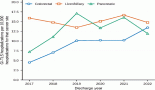
Post-treatment surveillance in colorectal cancer (CRC) aims to detect potentially resectable recurrences, but reported adherence varies widely across studies (12%–87%), and data from middle-income settings are scarce. We evaluated adherence to recommended surveillance after curative-intent treatment for stage I–III CRC in a Mexican tertiary referral centre and described longitudinal adherence trajectories. We conducted a retrospective cohort study of adults treated between 2014 and 2016 with ≥1 surveillance visit. Overall adherence over 3 years was assessed using standardised criteria (Cooper et al., 2008) and a modified definition adding ≥1 early (6–18 months) chest/abdomen/pelvis computed tomography (CT). Annual adherence to clinic visits, carcinoembryonic antigen (CEA) testing and CT imaging was calculated using dynamic denominators, and trajectories were classified as always, intermittent or never adherent. Overall adherence was 53.8% (95% confidence interval (CI) 43.7–63.7) by Cooper’s definition and 40.7% (95% CI 31.1–50.9) by the modified definition. Sustained adherence over 3 years was 69.2% for visits, 58.9% for CEA testing and 35.2% for CT imaging; adherence declined over time across all components. Colonoscopy within 3 years was completed by 87.9% of patients. In multivariable models, no prespecified patient or tumour characteristic was significantly associated with overall adherence. In this Mexican referral centre, consistent adherence to the complete surveillance package was low, primarily due to gaps in CT imaging. These findings suggest that, in resource-constrained settings, post-treatment surveillance should be strengthened through better care coordination, timely access to imaging and risk-adapted allocation of limited follow-up resources.

Supporting oncology professionals through education
The content on this site is intended for healthcare professionals only